Magazine
Narendra Modi’s Austerity Appeal: An Admission of Incompetence and Failure
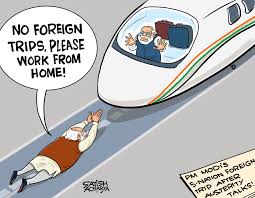
Prime Minister Narendra Modi has made a desperate appeal for austerity to the working people of India, calling for drastic cuts in the use of various essential commodities including fuel, edible oil and fertilisers. There has rarely been such a telling admission of utter incompetence, abject failure of governance and bankruptcy of foreign policy by any Prime Minister in recent times. Coated with the paint of “national interest” and termed as a “patriotic” duty to conserve foreign exchange amidst the ongoing West Asian crisis, he has in his usual style come out with the most preposterous propositions.
On the heels of the price hike of domestic LPG cylinders of Rs 60 in March 2026, now on 15 May 2026, the Prime Minister and his BJP-led Union Government has slapped a savage price hike of Rs 3 each per litre on petrol and diesel, and a hike of Rs 2 per Kg on CNG. This is having a grave and cascading impact on the entire price situation throughout the country.
The myGov poster with the heading ‘Nation First’ terms the strong suggestions of austerity as PM Modi’s 7 Appeals. The most callous appeal by the Prime Minister is “to reduce dependence on chemical fertilisers and move toward natural farming”. First and foremost, it comes at a time when farmers are already facing an acute agrarian crisis due to escalating costs, dwindling returns, indebtedness and are forced to commit suicide. Even as farm distress and policy driven farm suicides are continuing unabated, despite the grim situation just before Kharif sowing, the latest MSP announced by the Union Government also betrays farmers.
Unprecedented Fertiliser Crisis
India is the world’s largest importer and second largest consumer of fertilisers. The genesis of the fertiliser crisis is in a series of decisions of different Congress-led and BJP-led Governments’ policies that have eroded domestic industrial capacity as well as the policy of self-reliance. India’s import dependency for fertilisers is rooted in the history of deregulation and lack of investments by the BJP and Congress-led Governments. India’s subservience to the imperialist USA has also drawn it into a web of pressures and blackmail on trade relations.
Narendra Modi called upon the farmers to reduce fertiliser usage by up to 50 per cent and shift towards natural farming practices. It conveniently conceals the fact that even now the absence of ready availability of fertilisers is a major issue faced by farmers. Ironically, on the one hand the Government claims that fertiliser availability remains robust, and the supplies continue to exceed the requirement, while on the other their own Inter-Ministerial Briefing on Recent Developments in West Asia claims that fertiliser stocks for Kharif reach only 51% of assessed requirement of 390.54 Lakh Metric Tonnes.
Comparison with stocks in earlier years has no meaning given the fact that the US-Israel attack on Iran is a recent development; there is not going to be a smooth flow like earlier. The Strait of Hormuz accounts for the movement of 20 million barrels of oil per day, along with significant proportions of liquefied natural gas (LNG) and fertilisers. It is estimated that 1.5 to 3 million tonnes of fertiliser trade has been disrupted due to the tensions in West Asia. Movement of urea, phosphates, ammonia, potash, oil and LNG are all disrupted. Latest reports also suggest that shipments carrying essential fertiliser supplies through the Strait of Hormuz have also been abandoned by India, for fear of retributive sanctions by the US against any trade with Iran.
The Prime Minister and his spin-doctors are clearly underplaying the crisis and are in a dangerous denial mode. The Prime Minister’s call also comes just before the Kharif sowing begins for important crops like paddy, maize, soyabean, pulses, cotton etc. In the absence of timely availability of Urea and Di-Ammonium-Phosphate (DAP), yields will fall drastically, resulting in increasing farm distress, escalation of food prices, and a serious undermining of food sovereignty.
In reality, the available data on fertiliser consumption show that rather than excessive use there is a deficit in the actual consumption of key fertilisers when compared to the recommended levels of nutrient utilisation. This deficit is particularly with respect to the use of phosphorus (P) and potassium (K). Actual consumption of potassic fertilisers (K) stood at 2,384 thousand tonnes in 2024–25, which was nearly 64 per cent lower than the most recent normative or recommended consumption of 6,675 thousand tonnes. Similarly, consumption of phosphatic fertilisers (P) remained 11 per cent below the recommended level. Many States have a deficit even in the case of nitrogenous fertilisers (N).
Bankrupt Strategy of ‘Zero Budget Natural Farming’
Calling upon farmers to move towards a ‘Zero Budget Natural Farming’ instead of bolstering stocks necessary for the forthcoming Kharif season exposes the utter callousness of the Prime Minister; it is a sure-shot recipe for disaster. Such a policy could deepen the existing nutrient imbalance, which would in turn affect soil health and reduce crop yields. The earlier disastrous experiences of Sri Lanka and the reports from Sikkim that are now being show-cased as India’s 100% organic State have important lessons.
Sri Lanka’s shift to organic farming was without adequate biomass resources or capacity to produce bio-fertilisers to replace chemical fertilisers. It spelt disaster as severe shortages of nutrients needed for crop growth was reported and a drastic fall in productivity resulted. The agricultural shock pushed farmers into a precarious situation, food imports surged and prices increased; it gradually snowballed into an economic collapse as well as a political upheaval. The Prime Minister’s appeal for austerity also comes at a time when farm suicides are continuing unabated, a deficit monsoon is forecast and already fuel shortages are constraining irrigation. The austerity is not for the big corporate companies; it is for the working people who are already in distress and are already on the streets in protest. With these disastrous policies, the Prime Minister and the Union Government will have to brace for a new wave of militant united worker-peasant struggles.