Magazine
India-New Zealand FTA: Making India Subservient to Global Trade Structures


Are Free Trade Agreements (FTAs) with advanced capitalist countries beneficial to India without modernising domestic agriculture and transcending petty production to large scale production? This is the multi-billion-dollar question at the heart of India’s trade policy. The answer is: An FTA without domestic agrarian reform is a sell-out of the agricultural and MSME sectors to foreign market forces. When India opens its borders to a hyper-efficient, large-scale producer like New Zealand while its own farmers are still stuck in “petty production” – small, fragmented holdings—the impact could well be lopsided.
Vast Differences in Economy of Scale
A single New Zealand dairy farmer manages about 160+ hectares and 400+ cows using automated milking and satellite-guided pasture management. Conversely, the average Indian farmer manually manages 1.08 hectares and 2–3 cows. Without moving toward large-scale production via producer cooperatives and land pooling for collective cultivation with the aid of science and technology—Indian farmers cannot achieve the economies of scale needed to compete on production, productivity and price.
Even with tariffs, New Zealand’s cost of production is lower than India’s. The total number of farms in New Zealand was below 47,000 in 2022. Such consolidation has resulted in fewer but much larger holdings across most sectors. New Zealand’s agriculture employs approximately 5.6% to 6.6% of the total workforce, while in India 48% of the workforce is dependent on agriculture. New Zealand’s agriculture is an industry. India’s agriculture is a livelihood.
High mechanisation is essential for New Zealand’s farmers to remain globally competitive. The market for agricultural machinery has seen a strong recovery, with deliveries rising 10% in 2025. Precision Technology based mechanisation has evolved beyond basic tractors to include drones, GPS-guided systems, and sensors for soil and crop monitoring. Autonomous tractors and robotics for weeding and harvesting are increasingly being adopted to bridge the rural labour gap.
Comparing India and New Zealand in agriculture is a study in extremes: India operates on a massive scale with millions of smallholder farmers, while New Zealand operates a lean, industrialised, and export-driven model. A FTA between the two is a highly sensitive issue, primarily because of these structural differences. The dairy sector with 8 crore dairy farmers across India is excluded from the FTA, apprehending the pan-India resistance that could be unleashed. However, farmers across all sectors must unite and resist the implementation of the India-NZ FTA, which aims to make Indian agriculture subservient to the global trade structure. This agreement, like the earlier India-US and India-EU Trade Deals, exposes the anti-national Modi regime.
Apple Farmers in India Worst Hit
As part of the India-New Zealand FTA signed on 27 April 2026, New Zealand has gained a foothold in the world’s most populous market for its premium products, particularly high-end fruits, meat and wine. Apple growers in Himachal Pradesh, Jammu Kashmir, and Uttarakhand have expressed concern over the reduction of the duty on New Zealand apples from 50% to 25%. The minimum import price is $ 1.25 per kilo and as per the current currency rate the price will be Rs. 119. With a 25% tariff the New Zealand Apple will hit the Indian wholesale market at the net price of Rs. 148.75.
Also, the tariff on Kiwi fruits, mostly cultivated in Arunachal Pradesh and other North East States, which was 33% has been reduced to 0%, and the tariff on Manuka Honey, which was 66% has been reduced to 16.5% over a span of 5 years.
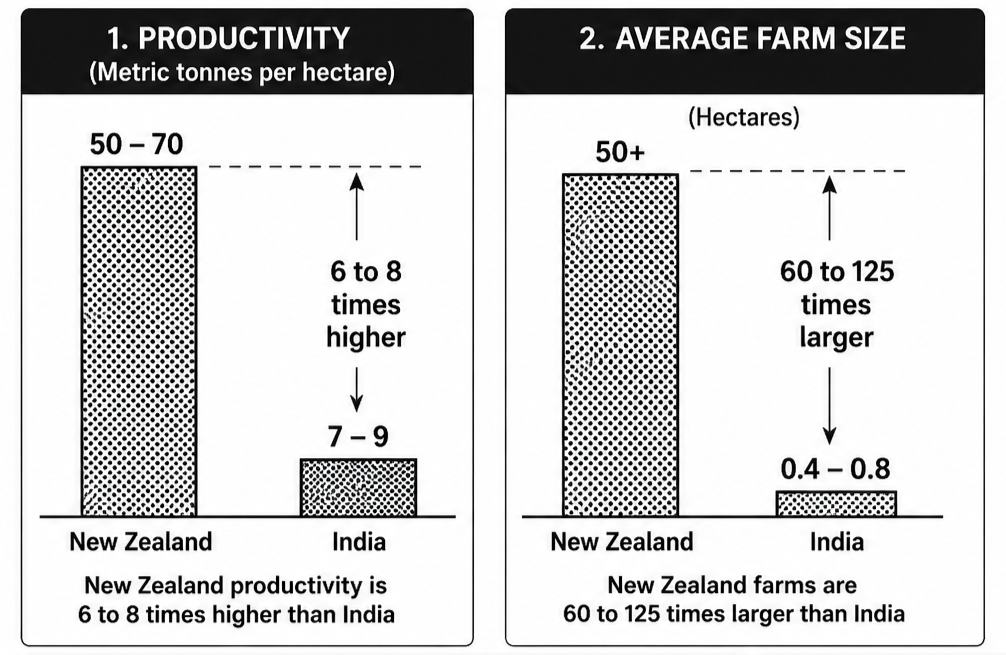
The apple productivity in New Zealand is 6 to 8 times higher – 50 to 70 metric tonnes per hectare—compared to 7 to 9 metric tonnes per hectare in India. In New Zealand the average farm size is 50 hectares plus. There are only 1,200 to 1,500 farms that produce 565,000 metric tonnes annually with 15th rank globally, but almost the entire production is exported.
In New Zealand the agricultural farm is an industry with heavy mechanisation, advanced planting techniques, rigorous supply chain management, and cold chain networks. Hence the cost of production will be much lower compared to that of the Indian apple farmers. In India, the average farm size is 1–2-acre land and the production is 25 lakh metric tonnes – 5th rank in the world—with 97-98% of Indian fruits being sold in the domestic markets.
The entry of New Zealand apples with a 25% tariff reduction will cause lethal damage to apple farmers in India. More than the issue of the impact on the domestic consumer market price, the fundamental issue is the relationship of production and marketing. Farmers in India are petty producers with low productivity and they are forced to sell their products at starvation prices to the large traders and their intermediaries.
The Modi regime has no plan to prevent exploitation in the domestic fruit market to help the hapless apple farmers in Himachal Pradesh, Jammu Kashmir, and Uttarakhand. Instead, to further intensify the exploitation and augment the profit of international corporate trade forces, the Modi regime has opened up India’s large domestic market to New Zealand’s most industrialised, advanced capitalist farmers with reduced tariffs.
Bonanza for Corporates, Disaster for Farmers
As part of the India-New Zealand FTA, New Zealand has made a binding commitment to facilitate $20 billion (Rs. 1,90,800 crore) in investment into India over the next 15 years. While this covers multiple sectors like manufacturing and infrastructure, a significant portion is dedicated to the agricultural and food processing sectors. Such direct foreign investment in the agricultural sector, which allows foreign corporations to dominate production, processing and marketing is dangerous to India’s sovereignty and security.
Foreign direct investment used to develop modern cold chain infrastructure and high-tech machinery, planting materials and farming methods permits Multinational Corporate Companies to dominate the apple economy in the border states of Jammu Kashmir, Himachal Pradesh, and Uttarakhand. This situation is also a security concern for India and must be discussed in Parliament as well as in state assemblies since agriculture is a state subject according to the Constitution of India. All the political parties and mass and class movements have to take serious note and demand the Modi regime to immediately suspend the India-New Zealand FTA.
Corporate India wants to integrate with the global trade structure, make investments, and amass profits from global trading. As the main political party representing the corporate class in India the BJP-RSS combine is succumbing to class interests while endangering the interests of farmers, workers, medium and small manufacturing enterprises, and the entire working population. More than the interests of India and its people, the Free Trade Agreements are aimed to protect the interests of the World Capitalist System and the developed capitalist countries currently struggling to come out of a systemic crisis.
Therefore, resisting the FTAs that harm India’s interests by rallying the farmers and workers and building a formidable alliance between them is the need of the hour. The AIKS and the Apple Farmers Federation of India (AFFI) are committed to advancing this struggle and ensure the repeal of the India-New Zealand FTA.