Magazine
Mass Protests Against Smart Meters and Electricity Privatisation in Rural India
Under pressure from the historic farmers’ struggle of 2020-21, the Modi-led BJP government was forced to surrender and repeal the three hated Farm Laws. At the same time, it had to reach a compromise, which included considering the farmers’ demand to withdraw the Electricity Amendment Bill. However, true to its habit, the Modi government broke its promise and is now moving forward with the Electricity Amendment Bill 2025.
This Bill will further the privatization of the power sector, and as part of this initiative, efforts are underway across the country to replace the old electricity meters with new smart meters. The installation of smart electricity meters has emerged as a major issue of conflict between governments, electricity distribution companies, and the people, especially farmers and rural consumers across India. What was introduced by the government as a “modernization” measure for improving power management has increasingly become a subject of mass protests in villages, small towns and cities. Constituents of the Samyukta Kisan Morcha (SKM), including the AIKS, have organized demonstrations, mahapanchayats, marches, and blockades against smart meters in several states.
The protests are not confined to one region. From Uttar Pradesh and Haryana to Punjab, Uttarakhand, Himachal Pradesh, Maharashtra, and Rajasthan, widespread anger has developed over allegations of inflated bills, prepaid charging systems, privatization of electricity services, and increasing burdens on farmers and rural households.
Background of the Smart Meter Scheme
The smart meter programme has been promoted by the Union government under power sector reform policies. Smart meters are digital electricity meters designed to automatically record consumption and communicate data remotely. Authorities claim that these meters reduce electricity theft, improve billing efficiency, and modernize power distribution systems.
However, farmers and consumer groups argue that the programme is being implemented without public consultation and mainly serves the interests of private corporations. Protesters also link the scheme to broader concerns regarding electricity privatization and the proposed Electricity Amendment Bill. There is one more threat – smart meters will end subsidized or flat-rate electricity systems used in agriculture and impose market-based pricing on rural consumers. There is also concern that prepaid smart meters could disconnect power supply automatically when balances are exhausted, severely affecting irrigation and farming operations.
Uttar Pradesh – Major Centre of Resistance
Uttar Pradesh has become one of the biggest centres of anti-smart meter protests. Farmers, villagers, and rural consumers have organized repeated demonstrations in many districts including Agra, Aligarh, Hathras, Firozabad, Lucknow, and Greater Noida. In April 2026, farmers mobilized in Lucknow at the call of the SKM, demanding withdrawal of the smart meter scheme and opposing electricity privatization. Protesters argued that the policy was anti-farmer and anti-people and warned of a wider movement if the government failed to respond.
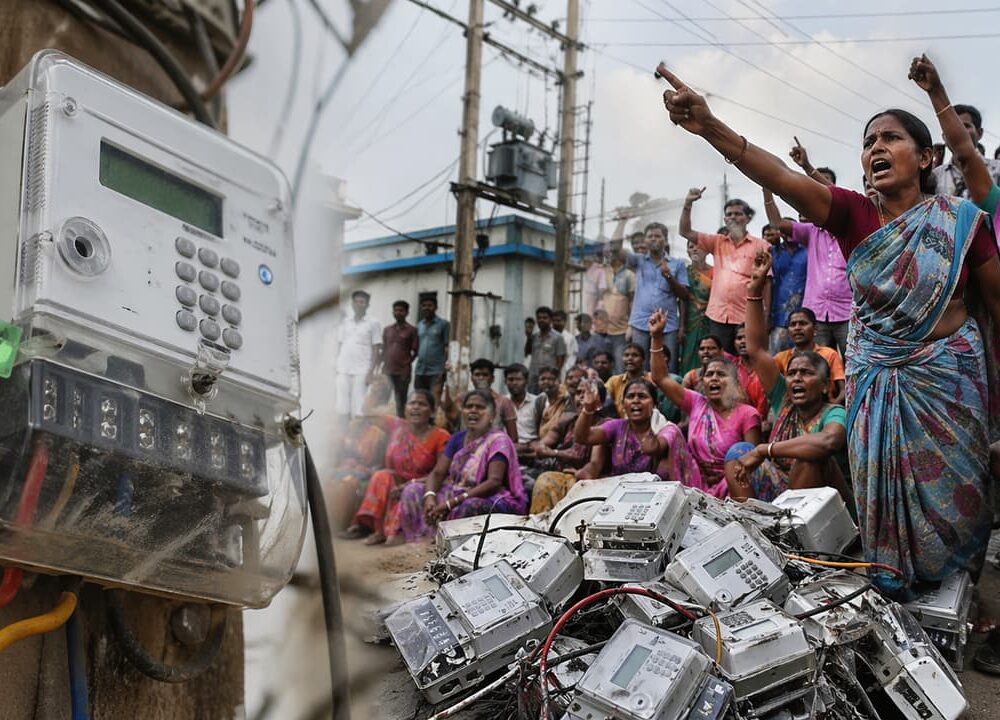
In the Braj region of Uttar Pradesh, protests became particularly intense. Villagers in Agra and nearby districts reportedly removed newly installed smart meters and dumped them at electricity substations. The protests spread rapidly to Aligarh, Hathras, and Firozabad. Farmers demanded continuation of old electricity meters and accused private companies of forcing installations without consent. Women also played an active role in these agitations. Large numbers of women participated in demonstrations carrying smart meters and raising slogans against electricity authorities. The protests reflected the deep anxiety among rural households regarding rising electricity expenses and uncertainty over billing systems.
Public pressure eventually forced the Uttar Pradesh government to partially retreat from its earlier policy. In May 2026, the government announced that domestic smart meters would operate under postpaid rather than prepaid systems after widespread public protests.
Haryana and Punjab – Mahapanchayats and Village Actions
Farmer organizations in Haryana have strongly opposed smart meters as part of their broader resistance to electricity privatization and pro-corporate reforms. A major state-level mahapanchayat held in Jind declared that farmers would not allow smart meters in villages. SKM leaders accused the government of using electricity reforms to benefit private corporations at the expense of peasants and workers.
In Punjab, resistance took an even more direct form. Farmer organisations in Ferozepur and Fazilka reportedly uprooted more than 500 smart electricity meters from villages and handed them over to electricity department officials. Kisan organisations argued that prepaid smart meters and electricity amendments would harm poor and middle peasants. Punjab farmers have long viewed free or subsidized electricity for agriculture as essential for sustaining cultivation. The introduction of smart meters is therefore seen as an attempt to dismantle long-standing support systems for farmers.
Uttarakhand – Clash Between Farmers and Police
In Uttarakhand, tensions escalated sharply during protests against smart meter installations. In August 2025, farmers marched towards Dehradun to oppose installation of smart electricity meters by private firms. Police stopped the march at a toll plaza in Haridwar district, leading to clashes between protesters and security forces. According to reports, several were injured during the confrontation.
Himachal Pradesh – Public Anger Over High Bills
In Himachal Pradesh, protests against smart meters have involved not only farmers but also employees, pensioners, traders, and ordinary consumers. Demonstrations were held outside electricity board offices where protesters described smart meters as “expensive and unnecessary.” Many residents complained that electricity bills had increased drastically after smart meter installation. A widely discussed incident involved a shop owner receiving bills amounting to tens of thousands of rupees for a closed property with almost no electricity use. Public frustration intensified as complaints allegedly went unanswered by authorities.
Maharashtra and Other States – Increasing Resistance
In Maharashtra, opposition to smart meters has also been growing. After a militant demonstration by the AIKS and CITU in Dahanu, withdrawal of smart meters was one of the important demands of the AIKS-led Palghar Long March of over 50,000 peasants. Traders, consumers, and political groups have protested against rising electricity bills and frequent power cuts allegedly associated with smart meter systems. Residents in Mahabaleshwar reported inflated bills and erratic electricity supply after installation of smart meters.
Similar dissatisfaction has surfaced in Rajasthan, Madhya Pradesh, Gujarat, and Jammu and Kashmir. Social media discussions and local protests indicate growing public scepticism regarding the technology, billing transparency, and privatization agenda.
Wider Political and Economic Significance
The anti-smart meter protests reflect deeper economic distress in rural India. Rising input costs, debt burdens, crop losses due to climate change, and uncertain market conditions have already placed severe pressure on farmers. In such a situation, any increase in electricity bills will be backbreaking for them.
The movement also demonstrates continuing rural resistance against neoliberal reforms in agriculture and public utilities. Many farmer leaders compare the present struggle to the earlier movement against the Farm Laws, emphasizing that electricity reforms could further weaken small and marginal farmers.
Another important feature of these protests is the unity between farmers, workers, pensioners, traders, and ordinary consumers. In several states, trade unions of electricity employees and farmer organizations jointly opposed smart meters and electricity amendment proposals. Chandigarh and Uttar Pradesh are good examples of this.
The protests against smart meters have emerged as one of the significant mass movements developing in rural India today. What began as complaints over inflated electricity bills has expanded into a broader political struggle against privatization, corporate control of utilities, and anti-people economic policies. The movement continues to evolve and may become an important issue in future agrarian and democratic struggles across India. AIKS and SKM maintain that affordable and accessible electricity is essential for agriculture, rural livelihoods, and social justice, and they have vowed to continue their agitation until their demands are addressed.