Magazine
Unite to Combat Trump’s Tariff Terrorism!
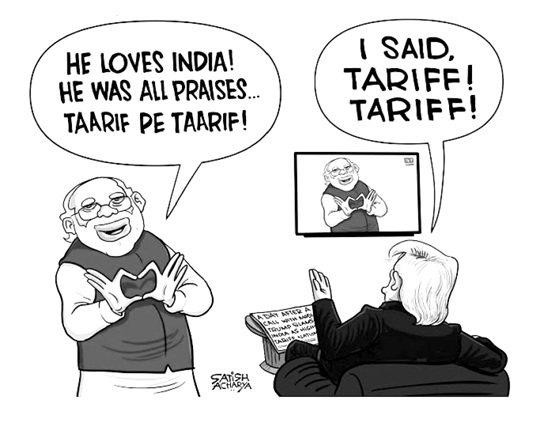
American imperialism under President Donald Trump has now started a full-fledged campaign of Tariff Terrorism not only against India, but also against several other countries of the world. But Trump has imposed the highest 50 % tariffs on Indian exports to the USA. Only Brazil has been slapped with such high tariffs. At the same time, Trump wants India to sign an agreement with the USA for free trade with almost 0 per cent tariffs on US exports to India.
Tariff means an entry tax on imports at the border, what we generally call import duty. These tariffs are part of a larger strategy by powerful Western imperialist nations to maintain their economic dominance, capture new markets, and usurp higher profits. When tariff is imposed selectively on a particular country, its exports become costlier compared to its competitors. Because of this, importers shift their orders to its competitors resulting in the loss of market of the country that is tariffed. As a result of this, the livelihood of the Indian people, especially of peasants, workers, and even small entrepreneurs running micro, small and medium enterprises (MSMEs), and the entire Indian economy, are facing a grave threat.
Which are the main Indian exports to the USA that have been badly affected by Trump’s Tariff Terrorism?They include a host of items like Textiles and Apparel, Gems and Jewellery, Sea Food, Leather Goods, Spices, Tea, Coffee, Cashew, Coir, and Machinery, Auto Parts and Organic Chemicals. The USA with around $ 80 billion imports from India accounts for nearly 20% of our merchandise exports. India also exports another $ 40 billion in services to the USA. The 50% Trump Tariff has affected around 60% of India’s merchandise exports to US. The total loss of exports to the USA is likely to be around $ 25 billion or ₹ 2.2 lakh crores. All this will have a disastrous cascading effect on the Indian economy, mainly unemployment and poverty, which have already become apparent in the last three months of the increased US tariffs.
We oppose Trump’s tariffs because they will adversely affect employment and income of the above sections. We oppose India removing its own tariff protection because that will also adversely affect their employment and income. Hence it has become imperative to mobilize the people of India against imperialist machinations and resist any attempt by the RSS-BJP government under Modi to surrender to the above demands of US imperialism.
The real objective of Trump’s Tariff Tantrums is to force India to sign a trade pact with the USA reducing India’s tariffs on import of agriculture products from USA. That is why Trump decided to put pressure on India by announcing 25% reciprocal tax above the 10% basic tax that already existed. To add further pressure, he imposed another additional 15% tariff as penalty for India purchasing crude oil at concessional rate from Russia. Trump wants to unilaterally punish India for importing oil from Russia on which the USA has imposed a trade embargo. Thus, in August 2025, the import duty imposed by the USA on India rose to a massive 50%.
Background of Imperialist Loot and Exploitation
For centuries together, imperialism has looted, exploited, and suppressed several countries of the world, especially in Asia, Africa and Latin America through its unprecedented colonial plunder and its series of inhumanly terrible wars, which still continue. For several decades after the Second World War, it used the weapons of its Multinational Corporations (MNCs), the World Bank (WB), the International Monetary Fund (IMF), the World Trade Organisation (WTO), and other forms of economic, political, and even military threats and coercion.
The disastrous neoliberal policies of liberalisation, privatisation and globalisation (LPG) were imposed from the 1980s. With the fall of socialism in the former Soviet Union and Eastern Europe in the late 1980s and early 1990s, imperialist aggressiveness in all spheres increased.
In recent decades, the intersection of imperialist trade policies and agriculture has become a defining issue for developing economies, particularly India. During the discussions on the signing of the WTO agreement, the imperialist and international organisations claimed that free trade leads to prosperity for all. Indian farmers were promised access to lucrative Western markets. Higher prices and increased incomes were the carrots dangled before them.
However, experience has shown that free trade policies have undermined the interests of Indian farmers and jeopardized the nation’s food security and rural livelihoods. Developed countries erect high tariff and non-tariff barriers to shield their own agricultural sectors. But India was compelled to reduce or eliminate such protections. Thus, there was a flood of cheap, subsidised agricultural imports into Indian markets, leading to a crash of agricultural prices.
In recent years, the WTO was facing irreconcilable internal conflicts between imperialist states and the emerging developing economies. The failure of the Doha Development Round exposed the inability of monopoly capital to impose a uniform trade regime on the Global South. In response, imperialist powers bypassed the WTO, and pushed bilateral and regional free trade agreements, to wrest more concessions from the developing world.
Such agreements included the Association of Southeast Asian Nations (ASEAN) agreement, Regional Comprehensive Economic Partnership (RCEP), Comprehensive and Progressive Agreement for Trans-Pacific Partnership (CPTPP), and the various US/UK/EU-led bilateral deals, to enforce stricter intellectual property rights, include investor-state dispute mechanisms (ISDS) that favour multinational corporations, and expand market access in seeds, dairy, and processed food. The shift to these bilateral and regional free trade agreements reflects the deepening contradictions of global capitalism in its neoliberal phase. We were able to successfully thwart the Government of India’s effort to sign the RCEP.
Dangerous Portents
The bilateral trade agreement discussions that were broken off after the unilateral punitive tariff imposed by US have now been resumed in New Delhi and Washington. The USA is mounting increasing pressure on India to surrender. The latest has been an exorbitant fee of Rs 88 lakh per H-1B visa. Restrictions on the entry of H-1B visa holders will directly and severely impact thousands of skilled Indian professionals and disrupt their careers. Sanctions on Iran’s Chabahar Port, a project operated by India, were also reimposed.
Equally serious is the fact that, under the pressure of both US imperialism and also the domestic corporate textile lobby, India was forced to remove its 11 % tariff on cotton imports from the USA. This will further depress the already low price of cotton got by farmers and lead to a sharp increase in farmer suicides, for which the cotton belt of the country is infamous. India was also forced recently to suspend its imports of cheap Russian oil simply because of Trump’s pressure. More belligerent actions from the USA in the days to come and more acts of surrender by the Modi government are more than likely.
We have the example of the European Union (EU), the United States’ largest trading partner, which initially opposed Trump’s demand, being coerced into signing a trade deal. Under the agreement, the US will impose a 15 % tariff on most EU imports while EU will eliminate all tariffs on US goods. EU promised to buy costly US fuel instead of cheaper Russian fuel.
In contrast we have the example of China, and even Brazil, standing up boldly to US threats. The US has now swallowed the belligerent counter-threats from China and has begun negotiating with the Chinese. The important lesson which the Indian government must learn from this is not to submit to threats but adopt a firm nationalist and pro-people stand.
But rather than resisting these strong-arm tactics, the Modi regime has chosen to respond with vague sermons about the need for self-reliance, and worse, by acts of surrender such as those mentioned above. This pathetic response is disappointing and humiliating for the country. The imposition of punitive tariffs and unacceptable language used by the US President reveals the total failure of India’s foreign policy and diplomacy. Trump has already triumphantly declared that a “good trade deal with India is round the corner”. “Good” for whom is clear from Trump’s remarks themselves.
What is to be Done?
If US pressures are to be resisted, it is important that India strengthen its ties with multilateral organisations like BRICS and SCO, and also with China, Russia, and other developing countries, to resist the US weaponisation of tariffs. The recent SCO meeting in Tianjin issued a joint declaration against US imposition of tariffs on various countries and its attempts to pressure nations into severing ties with Russia. A proposal for establishment of an SCO bank to serve the interests of the Global South was also discussed. The angry reaction of Donald Trump to the SCO meeting, claiming that it was ‘conspiring’ against the US, reveals the discomfiture it caused in Washington. India should realise that only by uniting all countries aggrieved by US actions can effective resistance be mounted.
We must diversify our exports and imports with the USA to other countries. India must resist US pressures to stop buying cheap Russian oil. During the period April 2022 to August 2025, Reuters has estimated that India has gained $ 17 billion as direct savings from importing Russian oil. However, these savings were largely pocketed by Reliance Industries and other oil companies. They must be passed on to the consumers in India. Many other important alternative steps need to be taken. Space does not permit a full list of such steps here.
The Government of India’s rhetoric of defending “strategic autonomy” in the trade negotiations has masked its adherence to the class interests of the bourgeois-landlord regime. Despite rhetoric, they have increasingly integrated Indian agriculture into exploitative, imperialist trade structures. If the Modi government succumbs to Trump’s threats, there would be a surge of cheap American imports—not just in dairy products, but also in wheat, cotton, and oilseeds like soybeans and canola. This would undermine India’s hard-won self-sufficiency in these commodities and threaten to displace millions of small producers.
The BJP stands for corporatisation of Indian agriculture, rapid modernisation, and greater export orientation. Opening up of the agricultural sector is an inevitable component of this package. The three black Farm Laws passed by the NDA regime were a prelude to this new strategy. They triggered the historic farmer agitation that forced the government to retract.
Modi’s unprecedented support for Trump’s election campaign, including the slogan “Ab Ki Baar Trump Sarkar,” has already weakened India’s negotiating latitude vis-à-vis American geopolitical and economic interests. The Modi government has failed to articulate a robust, pro-farmer position in bilateral negotiations. It has shown a willingness to make strategic compromises that endanger the interests of millions of rural and even urban households. Worst of all, instead of mobilising the entire nation to fight against imperialist threats, the BJP is still hell bent on dividing people on religious and caste lines. It continues on its authoritarian and neo-fascist path. This must be exposed and combated with vigour and determination.
The AIKS, and also the Samyukta Kisan Morcha (SKM), have opposed any moves that would further open up Indian markets to agricultural imports, warning that such policies represent a betrayal of the peasantry and a capitulation to foreign and domestic corporate interests. The ongoing debate over trade, tariffs, and the future of Indian agriculture is about far more than economic efficiency or international competitiveness. It is, at its core, a struggle for the very survival of the rural population and the principles of food sovereignty and self-reliance. Only a major pan-Indian struggle can force the government to take a path that protects India’s farmers and workers. And it is such a mass nationwide struggle which is the need of the times.