Magazine
Supreme Court Verdict in “Industry” Definition Case: Neither Promotes Industrial Peace nor Protect Workers’ Interest
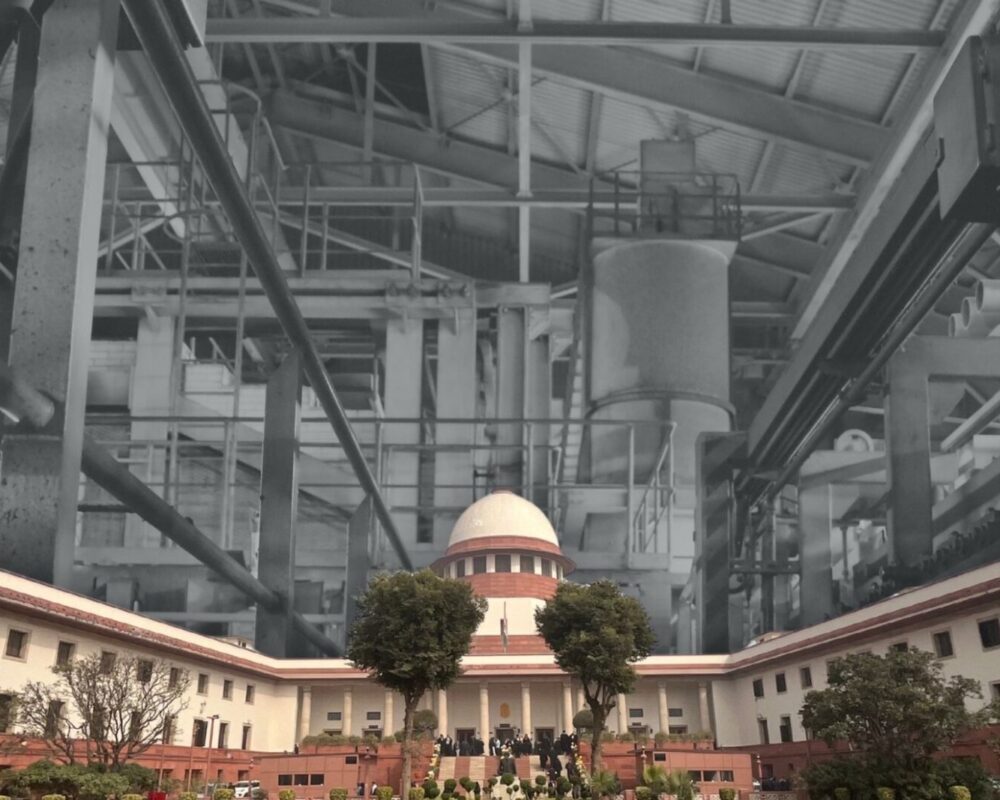
The Supreme Court’s nine-judge Constitution Bench, headed by Chief Justice Surya Kant, has delivered a spilt verdict on the meaning of ‘industry’ under 2(j) of the Industrial Dispute Act (I.D. Act) in the case of State of Uttar Pradesh Vs Jai Bir Singh. This bench was constituted, inter alia, to adjudicate on the application of the ‘triple test’ formula laid down to define ‘industry’ by seven-judge constitutional bench on Bangalore Water Supply & Sewerage Board v. R Rajappa & Other (BWSSB) which gave birth to an expanded definition of ‘industry’ that had brought millions of employees/workers working in hospitals, educational institutions, and those who are working under various government welfare schemes and statutory bodies under legal protection.
What Does Bangalore Water Supply Case Mean?
One labour dispute was raised when employees working for the Bangalore Water Supply and Sewerage Board contested the disciplinary action taken against them by the Board. The latter contended that it did not constitute an “industry” as per Section 2(j) of the I.D. Act, thus making its applicability to the matter unwarranted.
The case was referred to a seven-member Constitution Bench led by Chief Justice M H Beg in the Supreme Court. But Justice V.R. Krishna Iyer authored the majority judgment in 1978, which is considered one of the landmark judgments in labour jurisprudence in India. The Supreme Court clarified that the concept of “industry” is not confined to factories or manufacturing units. It can also include structured service-oriented activities.
The Supreme Court addressed the issue comprehensively. Justice V.R. Krishna Iyer’s majority opinion developed what subsequently became known as the “triple test” to determine what are the enterprises that come under “industry” u/s 2(j) of the I.D. Act.
Core Elements of the Triple Test set out in Bangalore Water Supply Case
If there is systematic activity, employer-employee cooperation, and production or distribution of goods or services for human wants, the organisation may qualify as an industry, even if there is no profit motive. Thus, an activity qualifies as an industry if it meets all three conditions:
- Systematic activity: The work is organised, structured, and methodical, not random or casual.
- Employer-Employee Cooperation (Relation): There is teamwork and coordination between the people who run the organisation and the people who work there.
- Production of goods or services: The work makes products or provides services meant to fulfill human needs and wishes (excluding purely spiritual or non-material goals).
Exclusions and Scope
- What is included: It covers hospitals, educational institutions, clubs, and government welfare bodies, even if they do not aim to make a profit.
- What is excluded: Sovereign government functions (like law and order or military defense), individual personal services, and casual, unorganised hobbies or tasks are left out.
Thus, the Supreme Court had made it clear that earning profit is not a necessary condition for an activity to qualify as an industry. What matters is whether the activity is systematic and organised, there is an employer-employee relationship, and goods or services are produced to satisfy human needs. If these elements are present, the activity may be treated as an industry, even if it is charitable, welfare-oriented, or government-run. In essence, the triple test shifts the focus from the purpose of the organisation to the functional nature of its operations and its employment structure.
Why Does the Definition of ‘Industry’ Matter?
Before the 1978 judgment, there was an ambiguity in the interpretation of Section 2(j) of the I.D. Act. It defines ‘industry’ in wide and vague terms such as any “business, trade, undertaking, manufacture or calling of employers”. It includes services, employment, handicrafts, and industrial employment of workers, but does not explicitly define whether educational institutions, hospitals, government organisations, philanthropic organisations, and professional organisations fall under it.
By bringing all these under the ambit of “industry”, that broad definition of BWSSB case had enabled workers to seek legal remedies concerning wages, working conditions, forming unions, calling strikes, do collective bargaining, and seek protection against arbitrary dismissal.
Who is Afraid of V R Krishna Iyer’s ‘Triple Test’?
Obviously, the capitalist class and its pressure lobbies were not satisfied with the definition given by Justice V R Krishna Iyer in the BWSSB Case. There were attempts to derail the Judgement by bringing in new labour legislations; one in 1978, and another in 1982. Both bills were resisted by the working class and were never passed by Parliament. Ultimately Parliament accepted the Judgement that was more visible as it was virtually borrowing Justice Krishna Iyer’s words when it amended the definition of “industry” in 1982. Though it borrowed and incorporated the triple test formula in the I. D. (Amendment) Act, 1982, it excluded a large number of workers from the ambit of the Act. It is fortunate that it was not notified.
The spectre of the ‘triple test’ had continued to haunt the employer class. Thus, in 2005, on the pretext of State of Uttar Pradesh Vs Jai Bir Singh, a five-judge Constitution Bench referred the Bangalore Water Supply judgment for reconsideration by a larger bench. It expressed a clear opinion that the definition adopted by Justice Krishna Iyer was “over-expansive”, “one-sided” and too “worker-oriented”. In his 2008 book, ‘The Court and the Constitution of India’, Justice O. Chinnappa Reddy responded to the reference:
“Perhaps the learned judges would also say that Articles 15 and 16 on Fundamental Rights and all the Directive Principles of State Policy were oriented in favour of the weaker sections and should therefore be interpreted strictly and not broadly.”
In the 2005 Reference, the majority opinion penned by Justice D.M. Dharmadhikari asserted that the statute must be interpreted to prevent exploitation of employers as well. In this background, the questions about the maintainability of this reference that were raised by the minority judges led by Justice Nagarathna should be understood by the working people.
After the 2005 reference, several Chief Justices came to the post and never took up the matter. Only 12 years later did a seven-judge Bench think it fit to refer the matter further. Another 9 years passed and until this year, no Chief Justice has ever thought to constitute a larger bench. On the other hand, the present Chief Justice decided to hear the matter, despite subsequent developments such as the passing of the Industrial Relations Code to replace the I.D. Act—Section 2(p) of the Code is a virtual reproduction of the 1982 Amendment.
Context and Contour of Nine-Member SC Judgement
In the meantime, a paradigm shift has taken place in the country and consequently in the labour law regime as part of liberalisation, privatisation and globalisation. Out of 44 Central Labour Laws, 29 were ‘subsumed’ into four Labour Codes. The aggressive drive for labour law reform which was aimed to dismantle existing entitlement and legal protections has drawn massive militant resistance from trade unions. A nationwide general strike on 12 February 2026 with participation of around 30 crore workers in opposition to the Labour Codes made headlines.
It is very relevant to recall, given this situation, the utterance of Chief Justice of India Surya Kant, while dismissing a PIL that sought a legal framework for enforcement of minimum wages for domestic workers, in the open court that trade unions were “largely responsible” for low industrial growth.
Hence, the four judges led by Chief Justice of India out of the nine-member constitutional bench miserably failed to legitimise the “project the value-set of the Constitution”, to borrow the words of V R Krishna Iyer and Directive Principles while interpreting the provision to provide succour to the vulnerable citizenry – the workers who produce wealth the entire society.
The judgement co-authored by the four judges held that the definition of “industry” under Section 2(p) of the I R Code, 2020 must be interpreted on its own terms, however having regard to its text, scheme, and object. It should not be “burdened” by the 1978 interpretation of Section 2(j) of the repealed I.D. Act.
Moreover, this ruling will remain applicable only to pending disputes/cases. This means that all matters presently pending before courts, tribunals, labour authorities or other fora under the I. D. Act, 1947 may be adjudicated in accordance with the triple test as laid down in Bangalore Water Supply Case.
On the other side, it is welcome to note that Justices Nagarathna, Datta, Bhuyan and Bagchi are substantially aligned in defending and preserving the 1978 position of Krishna Iyer. Similarly, Justice Narasimha also did not fully side with the Chief Justice of India and thus the whole judgment could not become a majority one as it was initially attempted to be made out.
Thus, this spilt verdict has sealed the application of triple test in future rulings. To quote, ‘In view of the opinion expressed herein and the hypothetical reformulation of the principles laid down in Bangalore Water Supply case, the said decision shall not be regarded as the sheet anchor for the interpretation of the IR Code or any of its provisions, should such a question arise in the future’.
Bourgeois Justice Oppresses Working People
If that is so, what is the necessity for Chief Justice Surya Kant’s hypothetical reformulations of triple test? Thus, nobody dares to invoke the triple test any more. Here it is more relevant to recall the remarks of Justice Gopala Gowda on this four-judges’ collective ruling that it is nothing but an attempt to police the tools available for a future interpretive exercise”.
Through the entire process of Labour Law Codification, millions of our working people have been excluded from coverage by increasing the threshold limits for application of the Code – that means they were kept out of legal entitlement and protection.
The Supreme Court has, indeed, gone further in legalising this exclusion and has refrained from upholding the application of the inclusive judgement of V. R Krishna Iyer to the Industrial Relations Code. Thus, it neither promotes industrial peace nor protects workers’ interest!
Among the various institutions of bourgeois society which serve to oppress and deceive the working masses, the bourgeois justice system is a very important one. This institution is carried on under the guidance of laws generally passed in the interests of the exploiting class. Whatever the composition of the court, its decisions are restricted as per the volumes of statutes that have incorporated all the privileges of capital and all the lack of privileges of the toiling masses.
As far as the organisation of the bourgeois justice system is concerned, this is always in perfect harmony with the characteristics of the bourgeois state. Let us understand the character of the bourgeois state and its organs and strategise accordingly to act!