Magazine
School Education in India: Why are Children on the Streets?
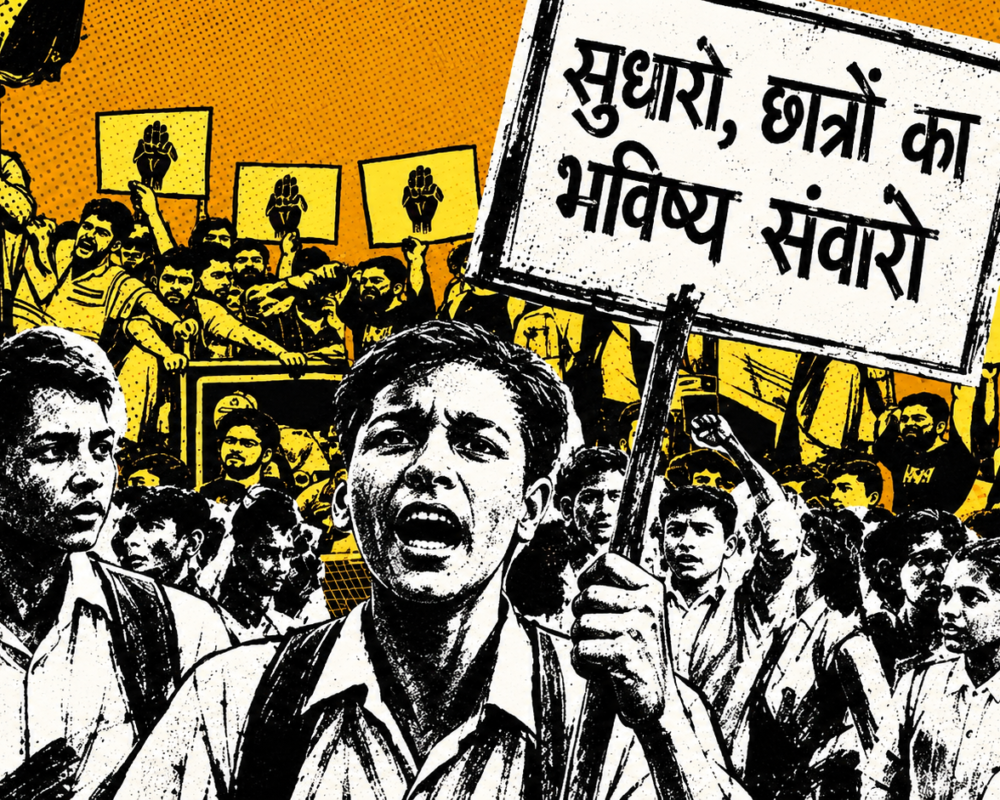
Following the courageous movement by India’s Generation Z (Gen-Z) that shook the powers that be, brought down a cabinet minister, and reignited hopes in the democratically-minded people of India – an even younger generation has grabbed the baton and drawn the nation’s attention to the dilapidated and utterly neglected state of India’s school system. The conversation around higher education had barely ebbed when videos of young schoolchildren, en masse blocking roads, picketing schools, and even scolding their principals and block education officers, demanding basic amenities like benches, teachers, drinking water, electricity, toilets, mid-day meals, etc became viral. Soon social media was flooded with such videos of Generation Alpha (Gen-Alpha) from at least ten states like Maharashtra, Bihar, Rajasthan, Jharkhand and Madhya Pradesh.
Like the Gen-Z movement, the spontaneity owes to long-standing frustrations among India’s students and youth. Growing up long after the effects of liberalisation have already set in, these children and young adults have only experienced abandonment by the state at different junctures of their life. Coupled with this, they have seen how a tiny minority of elite send their children to posh schools and abroad for higher education. This anger is therefore a class anger and as such has an objective basis, which we aim to explore in this article.
Vanishing Government Schools
First, a look at the UDISE+ or Unified District Information System for Education Plus (the educational management information system under the Department of School Education & Literacy) data. We are in the sixth year of the implementation of the New Education Policy (NEP) 2020, and the data is reflecting what educationists had forewarned when the policy was first floated for discussion.
There has been a reduction in the number of government schools and an even more drastic decline in their enrolment between 2022-23 and 2025-26, while an exactly opposite situation prevails with regard to private schools. The data says that between 2014-15 and 2017-18, the number of schools expanded steadily, from 15.16 lakh to 15.58 lakh. The trend reversed from 2018-19 onwards, showing a consistent decline. By 2022-23, the number of schools had dropped down to 14.66 lakh, representing a contraction of a whopping 92,000 institutions compared with the 2017-18 peak. There was a modest uptick in 2023-24, but the number remained stable in 2024-25 at 14.71 lakh, still significantly lower than the 2017-18 peak.
This decline, the government argues, was not “necessarily indicative” of a reduction in access but reflected a consolidation of school infrastructure, optimisation of resources, merger of under-enrolled institutions, and so on. While in absolute terms government schools continue to account for two-thirds of the total number of schools in the country, their numbers have declined from 11.07 lakh in 2014-15 to 10.13 lakh in 2024-25. In contrast, private unaided schools have recorded a steady growth, indicating the expanding role of the private sector in school education.
Students Dropping Out
Overall, enrolment has declined and the one category where the drop has been sharpest is among Scheduled Caste (SC) category students, whose enrolment declined by almost 1.4 per cent between 2022-23 and 2025-26. While it is undeniable that enrolment at pre-primary level has increased, even the combined enrolment at pre-primary and primary has experienced a reduction of 4.7 per cent. Seen in terms of the structure of stages of education of the NEP, enrolment has declined in foundational, preparatory, as well as middle stages and increased only at the secondary stage. One of the most positive findings of the UDISE+ data was higher enrolment for girls as compared with boys at all levels of school education. With compulsory education until the age of 14 becoming law, the percentages of enrolment appear to have gone up until the middle levels of education. However, the dip begins for all genders after that.
For example, the Gross Enrolment Ratio (GER), which is the proportion of student enrolment as a percentage of the population in a particular age group that is age-appropriate for that level of education, for both boys and girls at the foundational level (pre-primary to class 2) is 42.8 per cent. This goes up to 91.7 per cent at the preparatory level (Class 3 to 5). It remains more or less high at the middle levels too (class 6 to 8) at 89.6 per cent but takes a sharp dip at the secondary level, plunging to 71.7 per cent. The social categories (SCs, Scheduled Tribes (STs), and minorities) also reflect similar trends. One of the modest objectives of the NEP 2020 was to achieve 100 per cent enrolment until secondary levels by 2030. However, the current increase in enrolment at the secondary level reflects increases in primary enrolment in previous years. If the decline in primary enrolment continues, secondary enrolment will also decline.
A parliamentary panel has already flagged a sharp decline in the number of schools and students as education levels rise, with nearly 73 per cent of students dropping out before completing higher secondary education, while shortages of new textbooks and changing examination patterns are adding to academic stress among those who remain. The national average secondary dropout rate stands at 11.5 per cent, with West Bengal recording the highest rate at 20 per cent, followed by Arunachal Pradesh and Karnataka at 18.3 per cent each, and Assam at 17.5 per cent. The situation has also deteriorated in Uttar Pradesh and Bihar, with an increasing number of children dropping out of secondary education. In Bihar, the secondary dropout rate has risen from 2.98 per cent to 9.3 per cent, while in Uttar Pradesh it has increased from 0.52 per cent to 3.0 per cent.
No Toilets, Benches, Even Teachers
In the NITI Aayog’s “School Education System in India” report, it was stated that thousands of schools in the country are functioning without water supply, without toilets, without electricity, without labs, without teachers, and some do not even have students. If all this was not enough, only 10-15 per cent of the teachers in government schools can score above 60 per cent in the subject they teach. Over 1 lakh, or 8 per cent of all schools in India were single-teacher schools, with about 89 per cent of these schools located in rural areas. These cater to about 40 lakh students. In states like Andhra Pradesh and Jharkhand, up to 20 per cent of schools were staffed by a single teacher. There are around 7,993 schools in the country with zero enrolment. West Bengal has the highest number of such “ghost” schools, with 3,812, followed by Telangana with 2,245.
The reported figures give one side of the story, which when analysed across time show how school infrastructure that comes under the purview of the RTE and caters to children of the toiling people is taking a hit under the Modi government. The other side is the process of generating these figures – which is the datafication of education being pursued aggressively by this government. The school teacher, regardless of whether s/he was able to perform their duties as a teacher on a particular day, has to ensure they upload the school attendance data on the government server, often travelling large distances to access network. The quality of education, the pedagogical methods, etc are never quite captured by straightforward data meant to feed the UDISE+ database. When a single teacher is involved in teaching various grades, doing government work like election duties, even bringing ration to the school for the mid-day meal, the scope for a decent lesson being delivered is constrained.
In one of the first Gen-Alpha protests in a Sarvodaya Inter College in Uttar Pradesh, one class 12 student put it succinctly: “No one can imagine how difficult it is for us to study in the school. There is no electricity, so no fans during the hot and humid summers. We don’t have a drinking water facility. Many students sit on the floor because we don’t have enough benches. Hence we decided to protest.”
As the Modi government bets on the private sector in education (like it does in every other sector in the economy), crores of students from poor families, with ambitions to attain education are being forced into the darkness of ignorance. Students are pushing back against this very attempt. They do not want to become vigilantes and goons like the loudmouth Swatantra Bharadwaj and his ilk after dropping out. After the Gen-Z movement, Gen-Alpha is boldly asserting that they reject the Modi government’s hopeless and violent future for them. They will fight to chart their own bright futures.