Magazine
Results of the Bihar Assembly Elections – A Source of Deep Worry
The results of the Bihar Assembly elections announced on 14 November 2025 are truly unexpected. None of the metrics normally used to anticipate outcomes in a parliamentary democracy had given even the slightest indication of such results. On the one hand, the Nitish Kumar government—continuously in power for 20 years—had a heap of failures to its name, with hardly any noteworthy achievement to mention. Even within the NDA alliance there was restlessness; from roadshows to posters, scenes of ignoring and pushing aside each other were publicly visible. Rallies of Narendra Modi and Amit Shah often showed more empty chairs than filled ones. A political murder committed in broad daylight during the election had exposed the claims about the so-called absence of “jungle raj” under this regime.
On the other hand, the unity of the secular parties and the Left within the Mahagatbandhan (INDIA Bloc) was almost complete. They also had an alternative manifesto that actually addressed Bihar’s future. Their rallies drew thousands of people who came on their own, full of enthusiasm and energy. But the election results turned out to be exactly the opposite of what all this suggested, and the Nitish–BJP-led NDA secured an unexpectedly huge victory.
These results have shocked not only the country’s secular and progressive citizens and the political streams associated with the Mahagatbandhan, but also neutral political analysts and members of the non-Godi media and press. Detailed reviews are ongoing, and seat-wise analyses will also emerge in the coming days. But in reality, the results of the Bihar Assembly elections are deeply worrying. And this worry is not simply about who formed the government. It is deeper—if Bihar’s exceptional case becomes the norm, then how much of a parliamentary democracy we will remain, and for how long? And if Constitutional institutions and the conduct of those occupying them continues to deteriorate like this, then how long will the Constitution itself remain intact?
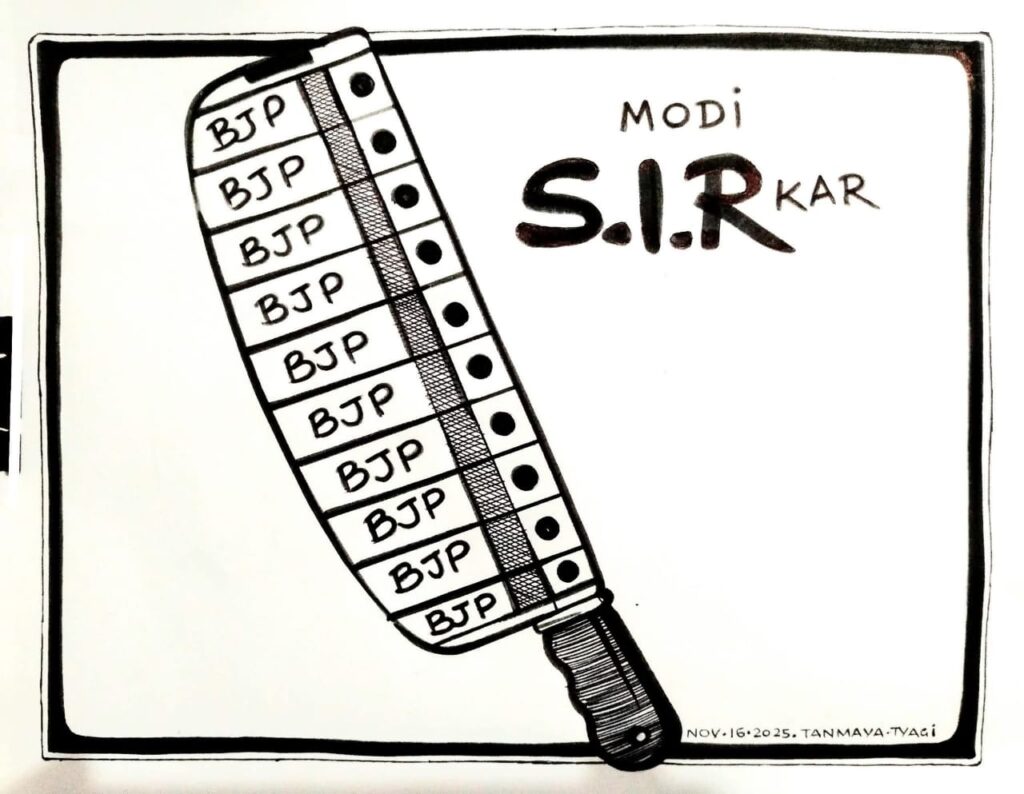
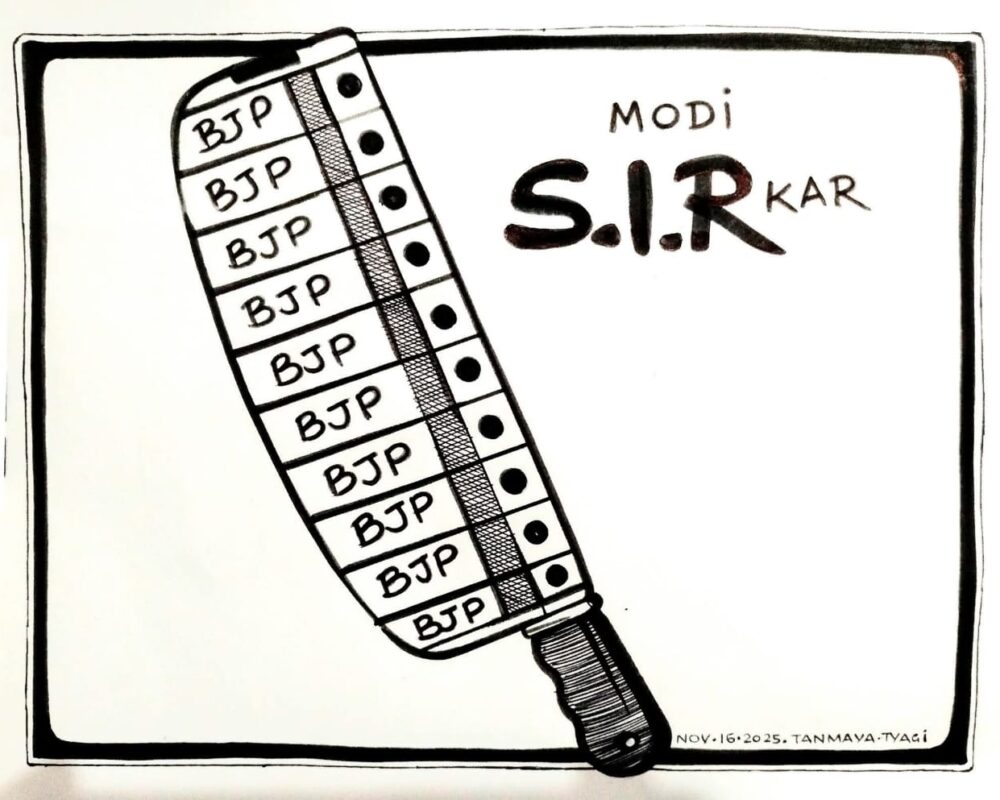
The script for the hijacking of the entire Bihar election was already written when, during the process of reconstituting the Election Commission of India, the Chief Justice of India was removed from the selection committee and replaced by a government representative. To complete the design, a law was passed granting Election Commissioners immunity from legal action for any illegality—an immunity even the President of India does not enjoy. This effectively puppet-like Election Commission then did exactly what it was instructed to do: the special revision of the electoral rolls under the name of SIR (Special Intensive Revision), notorious for its irregularities, was the first example. The hurry and haste with which it was carried out clearly revealed the intent behind SIR.
In a state like Bihar—where, in the 2020 Assembly elections, the difference between the NDA and the Mahagatbandhan was just 15 seats and only 11,150 votes; where a large population is forced to migrate for work; where backwardness and poverty are rampant—it does not take any special expertise to understand the social profile of the people who would fail to meet the conditions of SIR. From the beginning, SIR displayed a clear bias against the religious minority community as well. The alternative media continuously exposed how many types of irregularities took place. But “Modi Meherbaan to Gyanesh Kumar Pehalwan” went ahead and deleted 45 lakh names from the electoral rolls (earlier it was 65 lakh) without a care.
The apprehensions expressed earlier have been proved correct by these results. The 11,150-vote difference between the two alliances in the previous election became a difference of nearly 44 lakh votes in this election. Looking deeper, in 174 seats the margin of victory is smaller than the number of names deleted during the SIR exercise. Of the seats that the Mahagatbandhan had won last time but were “snatched” by the NDA this time, in 75 seats the margin of victory is less—much less—than the number of voters removed from the rolls.
The SIR and the targeted pruning of voters without consulting or even informing the opposition parties are not the Election Commission’s only feats. There is hardly any provision in the election process—meant to ensure equal opportunity for all political parties—that the Gyanesh Kumar-led Commission did not violate. Ever since Independence, the rule has been that once the election dates are announced, the Model Code of Conduct comes into force, and any announcement intended to lure voters becomes a punishable offence. Yet in Bihar, not only was the announcement made that ₹ 10,000 would be deposited into the account of every woman, but the cash transfers actually took place during the election—every Friday—up until the first phase of polling. The Election Commission sat silently. This was a direct case of exchanging cash for votes: about 1 crore 30 lakh women received roughly ₹ 14,000 crore.
Similarly, various other sections of women – Asha, Anganwadi, and Mid-Day Meal women, women’s self-help groups, and others – were also given generous doles just before the election was announced. Beyond this, there were numerous instances of cash distribution, many of which were caught red-handed and reported by workers of opposition parties. But both the administration and the Election Commission acted not just as passive spectators—they were often complicit in facilitating these acts. Institutions like Jeevika Didis were effectively turned into campaign workers for the NDA.
According to the rules, once election campaigning ends, no non-voter outsider is allowed to remain in the concerned constituency. Yet hotels across Bihar were filled with thousands of BJP workers brought from Gujarat, Maharashtra, Madhya Pradesh, and Uttar Pradesh. Reports—including photographs—emerged of these individuals even participating in the voting and casting multiple votes. Ministers, MLAs, and MPs from almost every BJP-ruled state were deployed for this operation. In Delhi, there was a bomb blast, and at the same time the Union Home Minister was sitting in a Bihar hotel—after shutting off all CCTV cameras—managing the election and conducting secret meetings with top administrative officials, assigning them their “tasks.”
Communal polarisation was also intensified. Those who believed that because Nitish Kumar was present, Hindutva rhetoric would be limited, were quickly disabused of this illusion. Not only did UP’s Yogi Adityanath and Modi’s minister Giriraj Singh spew venom, but even Amit Shah and Narendra Modi repeatedly fuelled this narrative. The remaining gap was filled by the MIM’s Owaisi, whose speeches inflamed minority communalism and who, by acting as the BJP’s B-team, has always helped the saffron camp.
Caste polarisation was also made an important factor in these elections. The impact of caste on elections in Bihar, and in many other states, is nothing new. But this time, the BJP-NDA used it to the hilt to mobilise a broad caste coalition to counter the traditional Yadav-Muslim combine of the RJD. The RJD-led Mahagatbandhan could also not transcend this base.
These results are worrying because the mechanisms and safeguards designed across the world to ensure free and fair elections have been dismantled. The bureaucracy, which blindly obeys the commands of those in power rather than working within constitutional limits, has already been exposed. The state of the judiciary is well known. Now the Election Commission has also been pushed into the stable, tying democracy to a post.
These results are also worrying because by distributing cash during elections, the citizenship consciousness of voters is being snatched away, replacing it with the mentality of petitioners and subjects. The concern is also that the poor and deprived are being prepared to shoulder the burden of their own destruction.
What happened did not happen suddenly. The RSS-controlled BJP has never claimed that it would contest clean elections. In their worldview and politics, conceivable or inconceivable, possible or impossible, moral or immoral, constitutional or unconstitutional—every kind of act, misdeed, or wrongdoing is legitimate. Everyone knew that they would engage in wrongdoing wherever possible.
The question now is: what should be done in such circumstances? First of all, blaming the people must stop. Then, the habit of looking for shortcuts must end. Forming alliances only at election time does not guarantee victory. Waking up only during elections is not enough. Continuous struggles—joint as well as independent—on real and perceived issues, struggles carried on until results emerge, along with the work of clearing the cobwebs of confusion and misconceptions in the minds of the masses, and building an organisation down to every village and settlement—this is what creates the path forward. Democracy was won through such struggles. It will survive only by intensifying them.