Magazine
Crisis of Employment in Contemporary India
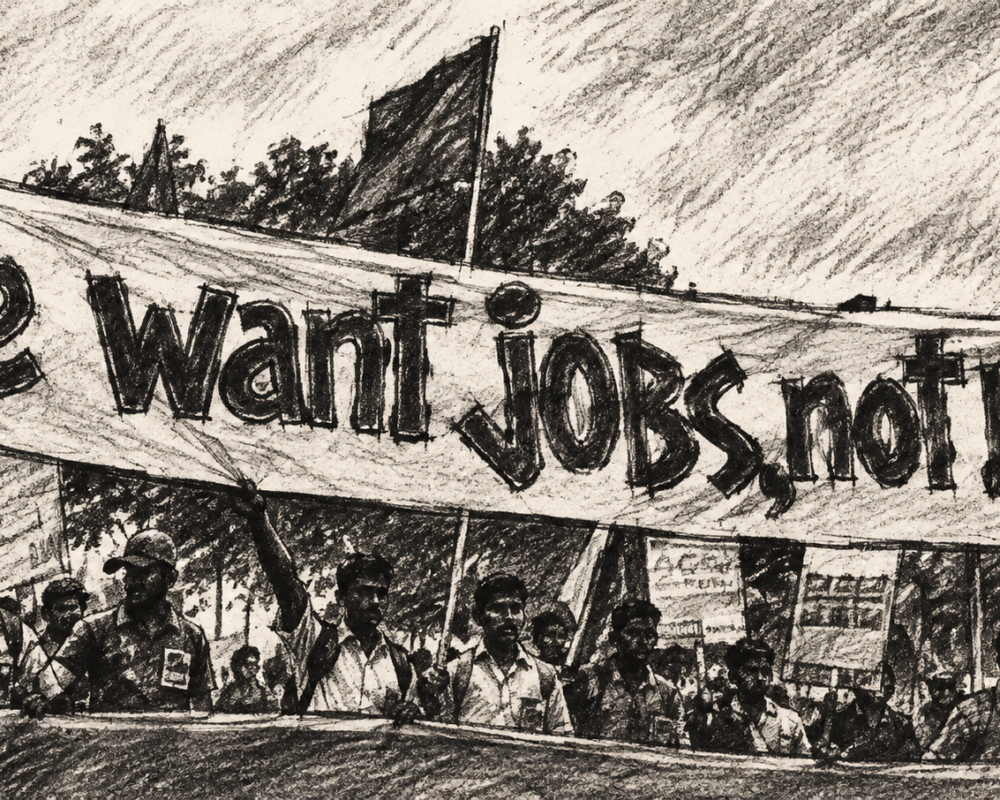
Widespread unemployment has emerged as the most vivid sign of the economic crisis that contemporary India faces. Neoliberal economic policies followed by successive governments in India since 1991, accelerated under the Modi government, have resulted in progressively worsening employment conditions for the working people. This crisis of employment is deeply connected to the agrarian crisis. In the virtual absence of any structural transformation of the rural economy, rural workers are increasingly forced to migrate or commute to urban areas in search of employment. A vast majority of these workers are employed in the urban informal sector with extremely precarious conditions of employment.
Instead of creating regular jobs with decent remuneration, neoliberal policies have resulted in a contraction of regular jobs and informalisation of employment.
Contraction of Government Employment
The contraction of salaried employment has been led by contraction of government jobs. The number of government jobs has been consistently falling since the 1990s, directly as a result of neoliberal policies of privatisation. In the 1990s, about 2 crore persons were employed in all government jobs (including central government, state government, quasi-government and local bodies). By 2012, this had fallen to 1.7 crore. In other words, there was an absolute reduction of about 30 lakh government jobs during that period. Since it came to power, the Modi government has stopped publishing comprehensive data on government employment (covering central, state and other government institutions). However, a steep fall in employment can be seen across different types of government employment. Total employment in public sector banks has fallen from over 10 lakh in the mid-1990s to just 7.5 lakh in 2024. The total number of employees in Central Public Sector Enterprises has fallen by over 4.5 lakh – a fall of 35 per cent – since 2014. Since 2014, the number of employees has fallen by about 80,000 in Railways, about 40,000 in the Department of Posts, and about 90,000 in public sector banks.
This article primarily uses statistical estimates from the Periodic Labour Force Survey (PLFS) of 2025. In a few places, it also refers to estimates from earlier rounds of PLFSs and data from other sources. As per the 2025 survey data, in the working-age population – which in this entire article refers to the age-group 21-60 years – only 9 per cent of women and 26 per cent of men had regular salaried jobs. Average monthly earning of salaried employees was just about Rs 17,500 for women employees and Rs 23,500 for men. Of these, only 1.6 per cent of women and 3 per cent of men were employed in some kind of public/government institutions which have some provisions for security of employment (though not all employees even in these institutions have secure employment). The largest number of men and women, 2.6 per cent of women and 7.4 per cent of men, worked in employers’ homes or small, proprietary or partnership firms, where even salaried employees have no security of employment.
As of March 2024, the total number of sanctioned posts in the Central Government was about 39.2 lakh. Between 2014, when the Modi government came to power, and 2021, the number of sanctioned posts increased by about 4.6 lakh. The biggest increase, of about 2.1 lakh, happened in 2018-19, on the eve of the general elections. However, this was reversed soon after elections and a large number of sanctioned posts were cancelled. Between 2021 and 2024, the number of sanctioned posts fell by 1.9 lakh. In other words, almost the entire increase in the number of sanctioned posts was reversed after the elections.
In addition, the government has kept many sanctioned positions vacant, and as a result, since the Modi government came to power, the actual number of central government employees has fallen by about 1.6 lakh. In 2024, there were about 8 lakh vacant posts in the central government, which was twice the number of vacant posts when the Modi government came to power in 2014. In Group C posts, about 2.7 lakh additional posts have been sanctioned since 2014, but vacancies have increased by 5 lakh.
Informalisation, Contractualisation and the Four Labour Codes
This contraction of regular salaried jobs, and in particular of the government jobs, has directly contributed to casualisation of employment. What started as a push for contractualisation of employment in public and private enterprises has, through a process of informalisation, now reached a stage where workers of vast corporations are not even recognised as employees of these companies at all. The four labour codes introduced by the Modi Government have significantly weakened government regulation of and worker protections in India’s private sector. Repeal of the Inter-State Migrant Workers Act has removed whatever little legal protections migrant workers had. The Industrial Relations Code has made hiring and firing of workers easier. The Occupational Safety, Health and Working Conditions Code has weakened regulations on occupational safety, raised daily working hour limits and expanded flexibilities in shift scheduling and overtime. The Wage Code’s floor wage has provided legal cover for paying wages lower than the statutory minimum wage.
The Codes have also institutionalized contractual employment across private industries. The growing army of gig workers in the private sector, all the scheme workers in the public sector, and home-based women workers to whom work is assigned through a network of jobbers and contractors are all denied even recognition as employees. In sectors such as construction and security services too, workers are hired through contractors with no liability of the real employers. The system of statutory inspections has been weakened, even as greater restrictions have been imposed on collective action by workers and trade unions, eroding their bargaining leverage.
Educated youth are the worst hit by the contraction of regular salaried jobs. If we look at persons with over 15 years of education in the age group 21 to 45 years, in 2025, about 27 per cent of men and 68 per cent of women among them did not have any gainful employment. Only 22 per cent of women and 45 per cent of men in this group had regular salaried jobs.
The Agrarian Crisis and the Decline of Agricultural Employment
In the working-age population in 2025, about 7 per cent of women and 15 per cent of men were casual workers with an average daily wage of Rs 324 and Rs 489 respectively. Of them, 5 per cent of both women and men worked as casual agricultural workers, and the rest worked in non-agricultural occupations. The agrarian crisis has hit the livelihoods of agricultural workers hard. Among casual agricultural workers in rural areas, women workers did agricultural wage labour only for 105 days in a year while male workers did agricultural wage labour for only about 62 days in a year. In the last eight years, average days of wage employment in agriculture fell by 37 days for male agricultural workers and by 48 days for women agricultural workers.
Contraction of agricultural employment pushes rural male workers to seek employment in non-agricultural activities, mostly as informal-sector workers in far-flung cities. In fact, rural male casual workers work significantly more days in non-agricultural activities than they do as agricultural wage labourers. In 2025, rural working-age male casual workers worked an average of 161 days in non-agricultural activities (compared to 62 days in agriculture). On the other hand, most rural women are forced to remain unemployed as most of them stay back in villages to look after the households. Among the poorest rural households, women also migrate to seek employment in cities.
Self-Employment and the Expansion of Petty Economic Activity
In the PLFSs, self-employment includes a category called “unpaid family helpers”, who are engaged in unremunerative, marginal activities. Persons engaged in such activities should not be treated as gainfully employed at all. Excluding these workers, we find that 10.6 per cent of women and 24 per cent of men were self-employed in gainful activities in 2025. Of these, almost 7 per cent of women and 12 per cent of men were employed in the primary sector, and less than 4 per cent of women and 12 per cent of men were engaged in some non-agricultural business. Most of these are also petty businesses. This is clear from the fact that 75 per cent of women self-employed in non-agricultural activities had gross earnings of less than Rs 316 per day, and 75 per cent of men self-employed in non-agricultural activities had gross earnings of less than Rs 833 per day.
This is the character of employment for most working people in India today. Barring a minuscule proportion, most working people are employed as casual workers, hold insecure salaried jobs, or are engaged in petty forms of self-employment. Women systematically earn less than men. Employment of Dalits and Adivasis is more precarious and less-remunerative than employment of other social groups.
On the other hand, in 2025, a whopping 42 per cent of the working-age population (21-60 years of age) was neither engaged in any remunerative economic activity nor attending any educational institution. This is the true measure of the scale of unemployment in India. A vast majority of them are women who are engaged only in housework or in other unremunerated activities. The fact that a large proportion of women are engaged in unpaid housework is often misrepresented as a voluntary choice. This is not at all the case: any rational person would accept employment that is commensurate with their capabilities, provides decent working conditions, and is suitably remunerative. There is no doubt that the patriarchal character of our society is responsible for passing the burden of care work disproportionately to women. The unavailability of well-paying jobs, even for highly educated and skilled women, also contributes to this. If well-paying jobs were available, many of these women would join the workforce. This would be conducive to more gender-equal relations within the households.
To sum up, neoliberal policies, pursued with an unprecedented vigour by the Modi government, have shrunk government jobs, informalised jobs in the private corporate sector and left a vast majority of working people dependent on the most casual forms of employment. A vast multitude of highly educated and young persons, particularly women, remains unemployed. Agrarian distress pushes rural male workers to migrate to cities for varying lengths of time chasing the most precarious and arduous casual work, while women are forced to withdraw from the workforce and do only care work within the confines of their homes.