Magazine
Editorial: Jantar Mantar has once again broken the Myth of the Modi Regime’s Invincibility
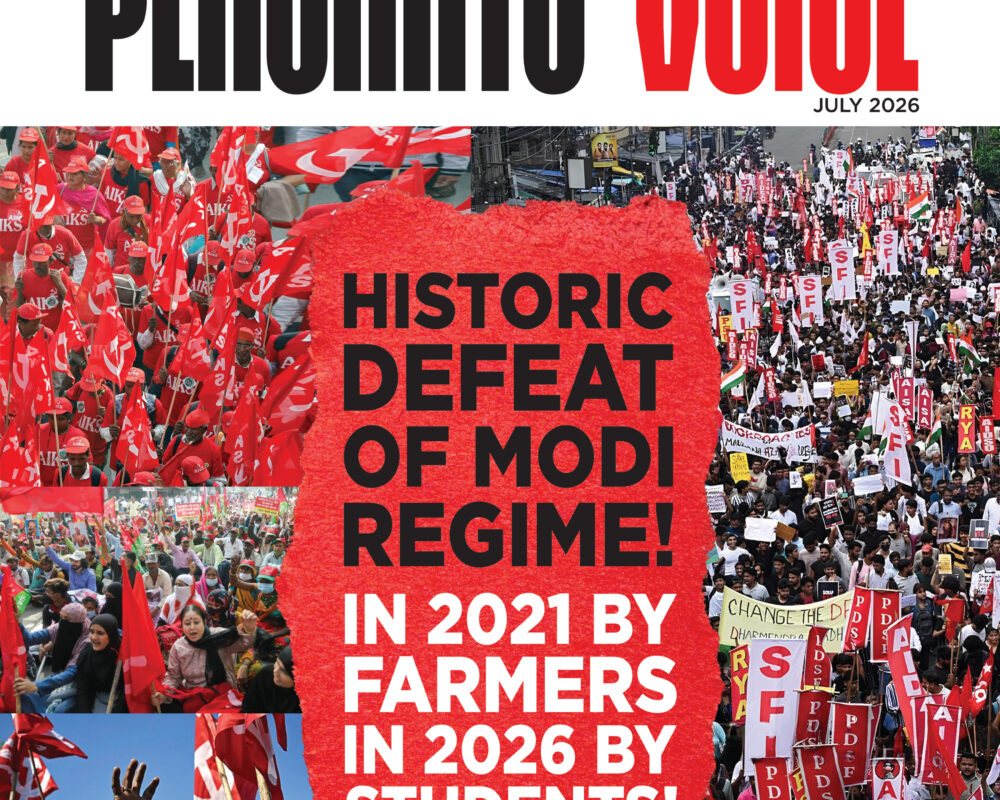
The magnificent victory of the students’ movement jointly led by the CJP and by Left student organisations like the SFI, AISF, AISA, and others which was centred on Jantar Mantar in the heart of New Delhi, has once again proved an old adage of the people’s movement: the people united shall never be defeated! When masses unite with determination around democratic demands, even the most powerful government can be compelled to retreat. The movement, born from anger against corruption in examinations, the crisis in education and employment, and the denial of a secure future, grew into a broader challenge to authoritarian governance. We pay homage to the 23 student martyrs of this struggle, who were forced to commit suicide because of the shocking leakage of the NEET question paper and the prospect of a re-exam.
Facing brutal police and paramilitary repression through lathi-charges, teargas shells, and even shock batons and AK-47 rifles, plus arbitrary arrests, threats and intimidation, the students displayed remarkable courage and solidarity. For this savage repression on students, there is no doubt at all that Prime Minister Narendra Modi and Home Minister Amit Shah are squarely responsible, and must be brought to book. The struggle showed that India’s youth refuse to accept a future defined by repression, corruption, insecurity, cronyism and arbitrary state power. The protests spread rapidly from Delhi to over 100 towns and cities, and ended only after the BJP-led government accepted several demands, including the resignation of the Union Education Minister Dharmendra Pradhan, giving the movement a significant political victory.
This victory did not emerge in isolation. It stood in a proud tradition established by the historic one-year struggle of lakhs of farmers at the Delhi borders led by the Samyukta Kisan Morcha (SKM) in 2020-21. Lakhs of farmers had then demonstrated extraordinary discipline, grit, and unity, facing both the callous government and the terrible Covid pandemic. 736 farmer martyrs laid down their lives. This struggle had also spread across the entire country through massive Kisan Mahapanchayats, ultimately forcing the Union government to withdraw the three black Farm Laws. That struggle shattered the myth that the Modi government was politically invincible. It demonstrated that sustained, united and peaceful mass mobilisation could defeat policies designed to advance corporate interests at the expense of farmers and rural livelihoods.
Similarly, the women of Shaheen Bagh in Delhi also wrote an unforgettable chapter in the democratic history of India. Their 101-day sit-in in 2019-20 transformed an ordinary public space into a symbol of constitutional resistance. Women who had rarely occupied public platforms became the moral conscience of the nation, asserting that citizenship, secularism and equal rights could not be surrendered without a struggle. Like the Jantar Mantars and Mahapanchayats across the country, the women’s movement also inspired similar Shaheen Bagh protests across the country and reminded India that democracy lives not merely in Parliament but also in the streets, neighbourhoods and public squares.
Together, these three recent mass struggles revealed some common lessons. One was the symbols which were common to all the three above protests. Photos of these symbols were there in all three protests – and those were of Mahatma Gandhi, Dr Babasaheb Ambedkar, Savitribai Phule, Periyar, Birsa Munda, Ashfaqullah Khan, and, of course, Bhagat Singh. The second were the common slogans in all three protests, which were, “BJP-RSS Sarkar Murdabad”, “Jai Hind”, and “Inquilab Zindabad”. And the third was the realisation that democracy survives only when people organise through massive popular movements.
The present political moment in India is marked by a sharp contradiction. On the one hand stands an increasingly authoritarian regime that has concentrated unprecedented political, economic and ideological power in its hands. On the other stands a growing current of democratic resistance—from students, farmers, workers, women, minorities, dalits, adivasis, and ordinary citizens—who have repeatedly demonstrated that organised mass struggle remains the most powerful force in Indian politics.
The present RSS-BJP-led government represents not merely a different political party but a project that combines neoliberal economics with communal nationalism. Wealth has become increasingly concentrated in the hands of the Adanis, the Ambanis, and other crony corporate houses even as unemployment, poverty, and inequality continue to affect millions. Public assets have been privatised, labour protections weakened and social welfare increasingly subordinated to the priorities of big capital.
At the same time, the government is systematically undermining democratic institutions. Opposition parties have repeatedly alleged, with very good reason, the use of investigative agencies for political purposes, the engineering of defections by elected representatives and the shameless splitting of opposition political parties from Maharashtra to Delhi to Punjab to West Bengal. The Special Intensive Revision (SIR) of electoral rolls risks disenfranchising lakhs of legitimate voters and undermining confidence in electoral democracy, while the Election Commission, which has become a lapdog of the Union government, fiddles while India burns.
The assault on secularism remains equally serious. India’s Constitution rests upon equality before the law irrespective of religion, caste or community. Yet communal polarisation has increasingly been used as a political strategy to divide working people who share common economic interests. Communalism serves ruling-class interests by fragmenting class unity. When workers and peasants are divided by religion, caste or ethnicity, they become less capable of challenging exploitation by economic and political elites.
The Ram Temple at Ayodhya occupies a particularly contentious place in this debate. It was a political mobilisation around the temple not as a spiritual project but as the appropriation of religious faith for electoral purposes. It diverted public attention from urgent questions of employment, education, healthcare and inequality. Now shocking facts have emerged of large-scale dacoity and siphoning off of huge amounts of donation funds by the RSS-controlled trust management itself! This is nothing but a blatant betrayal of the trust of millions of Ram Bhakts by the Ram keepers themselves!
Yet history repeatedly teaches that authoritarianism is never permanent. The farmers’ movement at the Delhi borders, the women of Shaheen Bagh and the students of Jantar Mantar each demonstrate that democratic resistance can overcome fear. Every successful struggle strengthens the confidence of ordinary people and weakens the aura of invincibility surrounding those in power.
India’s future will not be secured by communal division, corporate concentration or authoritarian governance. It will be secured by expanding democracy into every sphere of life: the workplace, the village, the university, the factory, and the institutions of the Republic. The promise of the Constitution can be realised only when political democracy is matched by economic justice and social equality.
The challenge before all of us today is to transform all these struggles into a broader democratic movement rooted in class solidarity. Workers demanding fair wages, farmers seeking remunerative prices, students fighting for education and employment, women resisting discrimination, Dalits confronting caste oppression, Adivasis defending land and forests, and minorities asserting equal citizenship all confront different expressions of the same unequal social order. Their unity—not merely electoral but political and organisational—offers the strongest foundation for democratic and secular renewal.
That is precisely why massive, intensive, and extensive people’s struggles, constant political and ideological battles, and building a broad but steeled organisation is the need of the hour.