Magazine
Rulers, Afraid of Democracy, Are Conspiring to Choose a New People!
There is a famous poem by the renowned German poet and playwright Bertolt Brecht, who stood firmly against the fascist dictators of the last century:
“The newspaper hawker was shouting in the street that the government had lost the confidence of the people. Now, through hard work, discipline and farsightedness alone could it win back support. But there was another way: the government could dissolve the people and choose a new people for itself.”
These days, this poem seems to have become the guiding principle of India’s present rulers. Particularly after the people, despite every effort and every unscrupulous tactic employed by the ruling establishment, deprived the BJP of a parliamentary majority in the 2024 Lok Sabha elections, their anxiety has turned into panic, and that panic has now reached the point of manipulating elections themselves. Indian democracy has perhaps been pushed into its gravest crisis. After every conceivable and inconceivable attempt to hijack it through deceit and manipulation, new methods are now being devised and implemented to render it completely meaningless. There are many such methods; let us look at a few.
Servile ECI, Savage SIR
In the spirit of Brecht’s poem, the Modi regime, riding on the back of the Election Commission of India (ECI), has set out to choose a new people for itself. The first step in this project is the campaign to filter out the “old people” through the so-called SIR — Special Intensive Revision of electoral rolls. In reality, this is a massacre of voters.
In West Bengal alone, nearly 9.1 million names were removed from the voter list — roughly 12 percent of the state’s electorate. What happened in Bengal went even beyond previous revision exercises. Trampling upon the federal structure of the country, the Election Commission even deployed an army of officials from outside the state to supervise the SIR process. The intention became evident from the profile of the first 6 million voters who were filtered out. An analysis found that the highest number of deletions came from Muslim-majority districts such as Malda and Murshidabad. Among those kept “under adjudication” — neither cleared nor formally disqualified — and among those declared “ineligible,” Murshidabad topped the list, followed by North 24 Parganas and Malda.
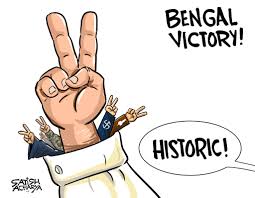
During a hearing in the Supreme Court regarding this process, Justice Bagchi himself observed that the Election Commission was applying a different procedure in Bengal than it had in Bihar. He noted that the Commission had introduced a new category called “logical discrepancy” in West Bengal, something absent in Bihar and other states. Another extraordinary development was that 2.7 million voters who were merely “under adjudication” — meaning they had not yet been found ineligible — were still prevented from voting. Justice Bagchi remarked that if the margin of victory were only 2 percent while 15 percent of voters had been denied the vote, it would send a deeply troubling message.
This is not the story of Bengal alone. In Uttar Pradesh, after a 166-day-long intensive revision process, the final electoral roll showed a reduction of over 20 million voters. On October 27, 2025, the frozen electoral roll listed 154.4 million voters. After the SIR process, the number fell to 133.9 million. Similar stories are unfolding in the other nine states where SIR has been conducted.
Whose Names are being Deleted?
Who are these people whose names are being deleted? Initially, it was claimed that these were illegal foreigners and infiltrators. This claim was made not only by the BJP but even by Chief Election Commissioner Gyanesh Kumar Gupta. Yet when asked to identify such infiltrators, they could not even name a dozen. The overwhelming majority of those being removed are poor people, labourers, migrant workers forced to move from place to place in search of livelihood, landless agricultural workers, and unemployed youth. They are not only economically weak but also belong to the lower rungs of the social hierarchy. A large number are religious minorities, especially Muslims.
This is the disenfranchisement of those voters who are not considered the BJP’s natural or potential supporters. It is the beginning of the exclusion of the deprived and working masses of India — precisely the objective long cherished by the BJP and its parent organization, the Rashtriya Swayamsevak Sangh. RSS ideologue “Guruji” M. S. Golwalkar repeatedly denounced the Indian Constitution as an imitation of the West and ridiculed universal adult franchise as mere “head-counting.” In his infamous book We, or Our Nationhood Defined, he wrote that Muslims should have neither voting rights nor any form of citizenship rights. When these current developments are viewed alongside such ideological foundations, the picture becomes even clearer: without formally suspending the Constitution or openly announcing the end of democracy, systematic efforts are underway to hijack it from within.
The complete collapse of the Election Commission’s neutrality is another grave outrage. Ever since Gyanesh Kumar Gupta assumed office, all pretence of impartiality seems to have vanished. Matters have reached the point where, instead of placing the Commission’s own seal on its orders, it appears to be stamping them with the BJP’s emblem. The institution constitutionally entrusted with ensuring free and fair elections is itself engaged in facilitating manipulation.
Avalanche of Bogus Voters
A recent revelation regarding the Assembly elections in Andhra Pradesh is a fresh example. One of those who exposed it was former Election Commissioner S. Y. Quraishi. He pointed out that nearly 4.16 percent of the votes were allegedly cast between 11:45 pm and 2 am — votes that overwhelmingly benefited the TDP-BJP-Jana Sena alliance. The Election Commission’s press release at 8 pm had reported a turnout of 68.12 percent. This figure was revised to 76.50 percent at 11:45 pm, and then, four days later, the final turnout suddenly jumped to 81.79 percent.
This implies that approximately 5.2 million votes were cast between 8 pm and 2 am. That amounts to one vote every twenty seconds, even though an EVM itself takes fourteen seconds merely to reset. There are also allegations that Form 17-C was never made public. Form 17-C, which is to be provided to all candidates through their polling agents immediately after polling concludes, contains the authenticated record of the EVM identification numbers, the total number of electors and voters, the number of voters who signed the register but did not cast their vote, those denied permission to vote, the number of test votes, and the total votes recorded in each EVM. According to former Election Commissioner Quraishi, making this form available is the duty of election officials and therefore of the Election Commission itself. Why was this not done in Andhra Pradesh? The answer perhaps lies in those mysteriously added five million votes.
In Maharashtra, in the May 2024 Lok Sabha elections, the INDIA Bloc won 31 seats out of 48, leaving only 17 seats to the NDA. Just six months later, in the Vidhan Sabha elections in November 2024, there was a ‘miracle’. The NDA won 235 seats out of 288, leaving the INDIA Bloc with just 50 seats. Apart from other factors, ECI records showed that many more new voters were enrolled in Maharashtra in those six months than in the previous five years!
This same bogus voter story was revealed with proof in the 2024 Lok Sabha election in the Bangalore Central seat in Karnataka. There are actual eyewitness reports of trainloads of bogus voters being mobilised by the BJP from other states for the Bihar and Bengal elections.
Shameless Communal Appeals
One is reminded of a case from the 1990s, when the Supreme Court upheld a Bombay High Court judgment annulling the election of an MLA from the Vile Parle constituency because of a speech delivered during the campaign by then Shiv Sena chief Bal Thackeray. In that speech, Thackeray had declared: “We are contesting elections to protect Hindus. We do not care for Muslim votes. This country belonged to Hindus and shall remain theirs.” On the basis of such speeches, the court held both the candidate and the campaigner guilty of corrupt electoral practices. Not only was the MLA unseated, Bal Thackeray himself was disqualified from voting for six years.
Today, however, even when the Prime Minister, Home Minister, and BJP Chief Ministers openly raise communal issues during elections, the Election Commission maintains a deafening silence. This is no longer mere negligence or indifference; it amounts to complicity.
Money Power Distorts Elections
The Election Commission of India was once expected to prevent the use of money power during elections, to stop inducements and the distribution of largesse for votes. Once the Model Code of Conduct came into force, even populist announcements by governments would be restrained. The purpose was to ensure a level playing field. Today, money is being distributed openly; thousands of crores are changing hands; entire parties and leaders are being bought and sold. Governments led by the Prime Minister and his party openly practice cash-for-votes politics, transferring thousands of rupees into voters’ bank accounts just before polling. Where, then, is the Election Commission?
Where is the Supreme Court?
And, most important, where is the Supreme Court? It is only the Supreme Court which could have stopped this deadly SIR assault on democracy. It could have stopped the poisonous communal election appeals by the Prime Minister, Home Minister, and several BJP Chief Ministers. It did nothing. It only contented itself by uttering some platitudes.
Democracy in India was not bestowed on us as charity or gift. It was won through countless sacrifices in the great struggle for independence against the brutal British. If Hindutva-driven communal forces, who were nowhere in that great struggle, but who are now seated in the lap of corporate power, conspire to snatch it away, then it is the people of this country themselves who must rise to defend it.