Magazine
The Struggle of Mewati Farmers Against Loot and Unjust Land Acquisition for IMT Sohna
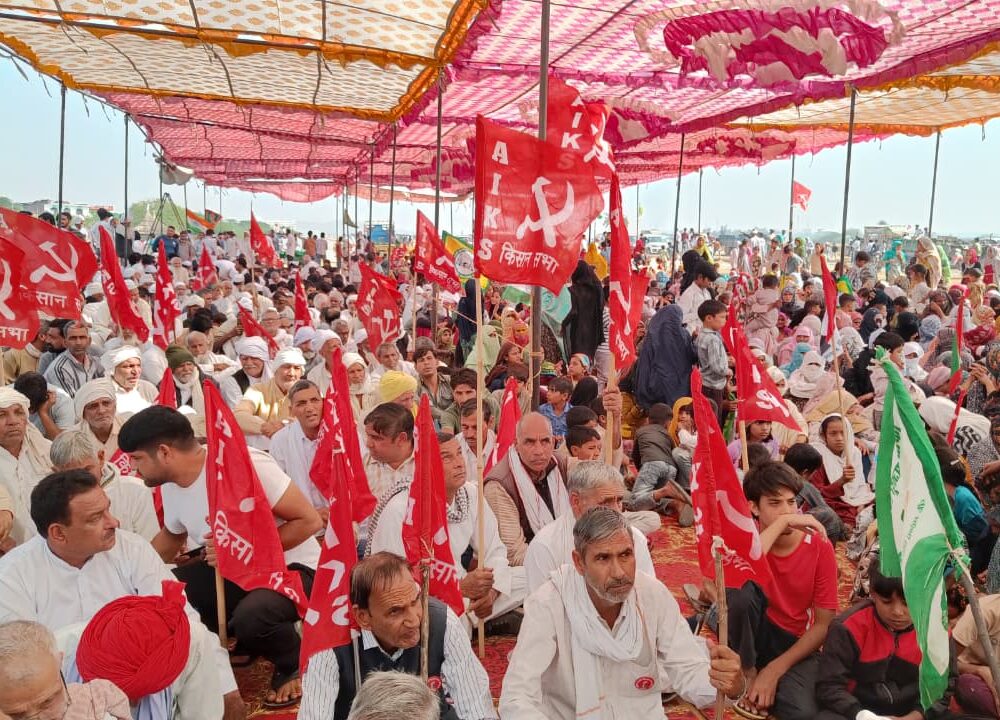
Barely 60 kilometres from the heart of the national capital, New Delhi, farmers in Haryana’s Nuh district have been fighting for the past 13 years against deception, betrayal, and looting. Situated in the Mewat region and adjacent to the so-called Millennium City Gurgaon, Nuh district is the most backward in Haryana. The main reason for this continued backwardness lies in its political neglect — largely because it is the only Muslim-majority district in the state. Along with other forms of discrimination, the farmers here have been deliberately given the lowest land compensation in the entire National Capital Region (NCR).
The farmers of Nuh have been waging a long struggle for fair compensation for the unjust acquisition of their land for the Industrial Model Township (IMT) Sohna, but their demands have been continuously ignored.
In 2010, the then state government announced the establishment of an Industrial Model Township (IMT) at Rozka Meo in Nuh district. For this purpose, the Haryana State Industrial and Infrastructure Development Corporation (HSIIDC) acquired around 1,500 acres of land from nine villages situated between Sohna and the Kundli–Manesar–Palwal (KMP) Expressway during 2010–2012.
During the 2010 acquisition at Rozka Meo, the government initially offered compensation of ₹25 lakh per acre, which the farmers opposed and demanded to be increased. However, through deceit, the authorities managed to get the farmers’ signatures on documents mentioning ₹46 lakh per acre as compensation, and at the same time, forced them to sign an agreement waiving their right to approach the court against this injustice.
Meanwhile, farmers in the nearby village of Chandawali were awarded ₹2 crore per acre by the court. At present, the land developed by HSIIDC is being sold at market rates ranging from Rs 13 crore to Rs 18 crore per acre, while the latest registered rate has reached Rs 23 crore per acre. The exact prices depend on the plot size, location, and other features.
The agreement did not even respect the provisions of the Land Acquisition Act, 1894, let alone the farmer-friendly provisions of the Land Acquisition, Rehabilitation and Resettlement Act, 2013. Even landless agricultural-workers dependent on agriculture in these villages were not given any compensation.
Under Section 18 of the Land Acquisition Act, 1894, the right to approach a civil court is a statutory right, and no agreement can take that away. Any contract made under pressure that deprives a citizen of their fundamental or statutory right to seek judicial review can be legally challenged and declared invalid by the court.
The extent of this loot can be understood from the fact that land acquired from farmers at ₹46 lakh per acre is now being sold by the government to private companies for ₹23 crore per acre — a profit of nearly 50 times. Furthermore, the agreement stated that farmers whose more than one acre was acquired would be given a 400-square-meter residential plot, and those with less than one acre, a 200-square-meter plot. But now the government is charging farmers ₹12,240 per square meter for these plots — meaning ₹48.96 lakh for a 400-square-meter plot. This means that for the same one acre (4,047 square meters) of land that was bought for ₹46 lakh, the government is now demanding more than that amount just for 10% of the area, effectively looting the farmers from both sides.
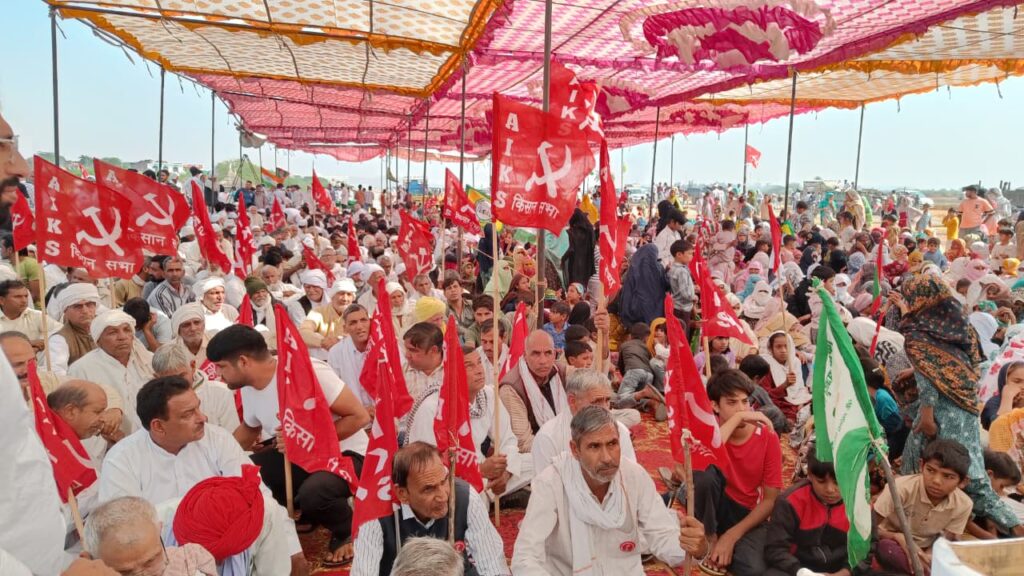
Across the entire NCR region, the farmers of Mewat have been given the lowest compensation, and even their right to protest has been restricted. The farmers from these nine villages have been continuously struggling and have been sitting in protest for the past two years. During this period, they have organized several panchayats and demonstrations, during which many farmers were detained, arrested, and cases were filed against them. However, the administration and government have taken no concrete steps to address their demands.
One of the most positive aspects of this movement is the strong participation of women and youth in this Muslim-majority area. The movement is being led by the IMT Sohna Kisan Sangharsh Samiti, which is part of the Samyukt Kisan Morcha (SKM) — and SKM is carrying this struggle forward.
On 6 November, the Kisan Sangharsh Samiti organized a Kisan Mahapanchayat, attended by both state and national leaders of SKM. Under pressure from this mobilisation, the district administration promised to arrange a meeting between the farmers and the Chief Minister soon, and to halt all construction work by HSIIDC until that meeting took place. However, betraying the farmers once again, the very next day the district administration refused to stop the construction work and gave no clear assurance about the meeting with the Chief Minister.
Despite these betrayals, the farmers are moving forward with confidence, facing administrative indifference and government hostility, determined to intensify their struggle. Their main demands are:
- Cancellation of the 2012 affidavit/agreement that denies farmers their right to judicial review. The state government must issue a notification to cancel it and start direct dialogue with the farmers.
- Right to additional compensation of Rs 2 crore per acre as additional compensation.
- Right to promised residential plots of 400 square meters for each landowning family and 200 square meters for each landless family.
- Right to employment for all affected families, including the landless, should be provided jobs in industries and service sectors established in IMT.
Right to public amenities like proper arrangements for drinking water, sewerage, ponds, electricity, service roads, schools and higher education institutions, hospitals (from primary to specialized care), playgrounds, children’s parks, community centres, old-age homes, graveyards, cremation grounds, public libraries, cultural complexes, industrial training and skill development centres, and citizen service centres.