Magazine
Towards the AIKS 36th All India Conference: 90 Years of the AIKS, 80 Years of the Telangana Struggle, Challenges Ahead
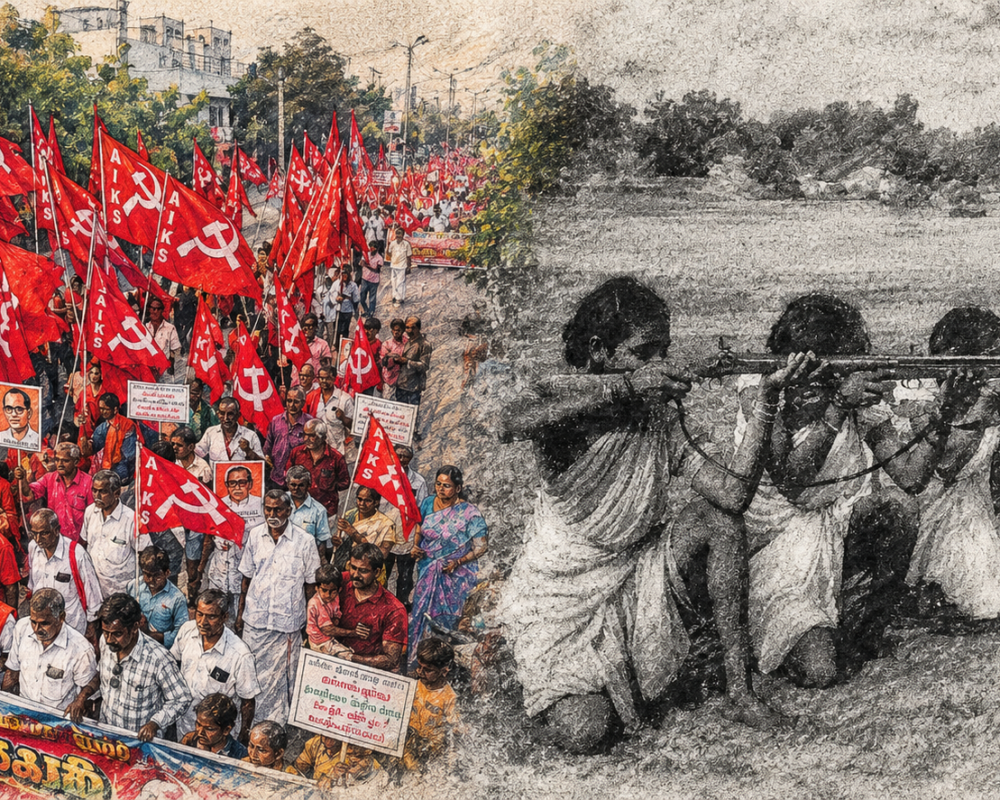
The 36th National Conference of the All India Kisan Sabha (AIKS) will be held at Nalgonda, Telangana, from November 15 to 18, 2026. The year 2026 marks 90 years since the founding of the AIKS at Lucknow on 11 April 1936. It also marks 80 years since the beginning of the iconic Telangana peasant struggle on 4 July 1946. The decision to hold the 36th Conference at Nalgonda, one of the epicentres of that historic struggle, gives it a special significance.
The 36th AIKS Conference has to carry out three responsibilities: recall with pride the glorious legacy of the AIKS; make an objective analysis of the new agrarian and political challenges; and set a concrete direction to launch massive struggles and strengthen our organisation to confront those challenges, so as to advance towards our objective of an agrarian revolution.
Birth of the AIKS, Lofty Objectives
On 11 April 1936, the AIKS was born in its foundation conference at Lucknow in the crucible of the magnificent freedom struggle of the Indian people against British imperialism. The AIKS is today the oldest and the largest peasant organisation in India – with a membership of over 1 crore 58 lakh (15.8 million) spread over 460 districts in 27 states of the country.
The Lucknow founding conference of the AIKS was addressed by the then Congress President Jawaharlal Nehru, who extended solidarity and acknowledged that the peasantry was the most exploited section of society. The conference was attended by a galaxy of illustrious leaders across the country. They included Swami Sahajanand Saraswati, E M S Namboodiripad, Sohan Singh Josh, Lal Bahadur Shastri, Jayaprakash Narayan, N G Ranga, Ram Manohar Lohia, Hare Krishna Mahtab, Dinkar Mehta, Indulal Yagnik, Kamal Sarkar, Nabakrushna Choudhury, K M Ashraf, K D Malviya, Mohan Lal Gautam, B Sampurnanand, R K Khadilkar, Sarat Sinha, Bishnuram Medhi, Ahmed Din, and Sudhin Pramanaik. Swami Sahajanand Saraswati was elected the first President of the AIKS, and N G Ranga was elected its first General Secretary.
In its main resolution, the Lucknow Conference clearly set out the lofty objectives of the AIKS: “The objective of the Kisan movement is to secure complete freedom from economic exploitation and the achievement of full economic and political power for the peasants and workers and for all other exploited classes…..The main task of the Kisan movement shall be the organisation of the peasants to fight for their immediate political and economic demands in order to prepare them for their emancipation from every form of exploitation…..The Kisan movement stands for the achievement of ultimate economic and political power for the producing masses through its active participation in the national struggle for winning the complete independence of India.”
The conference adopted a Kisan Manifesto demanding abolition of the zamindari system, reduction in land revenue, cancellation of rural debts, and land to the landless to be cultivated on the basis of cooperative farming. It declared the zamindari system to be “discriminatory, unjust, burdensome and oppressive” and called for giving land to the tiller. By 1937, the AIKS adopted the red flag as its banner, signalling its shift toward militant class-based politics.
Historic Peasant Struggles Before Independence
Ever since its inception, the AIKS has led a long series of historic and victorious struggles of the peasantry across the country. It has valiantly faced the most brutal repression from the British regime, the Congress and BJP regimes, all kinds of communal, casteist, and divisive forces, and from the landlord/corporate lobbies and their goons. Thousands of AIKS activists across the country have been martyred in innumerable struggles for their rights.
With legendary peasant struggles like Telangana in then Andhra Pradesh, Tebhaga in Bengal, Punnapra Vayalar and North Malabar in Kerala, Gana Mukti Parishad in Tripura, Bakasht in Bihar, Warli Adivasi Revolt in Maharashtra, and Surma Valley in Assam, the AIKS became the largest and most powerful peasant organisation in India. Other important pre-independence struggles included the Muzara tenant struggle in Punjab, the Shekhawati movement in Rajasthan, the struggles against landlordism in Kashmir, and the peasant-backed Parallel Governments against the British in Satara, Maharashtra (three years), Tamluk, Midnapore, West Bengal (two years), and two short-lived ones in Ballia, Uttar Pradesh, and Talcher, Odisha.
Agrarian Trajectory after Independence
The transfer of power in 1947 did not end feudalism. Zamindari abolition acts were passed in some states by various Congress regimes, but there were several loopholes in them and their implementation was poor, favouring the landlord lobby. Land concentration increased on the one hand, and landlessness on the other; this was much more intense among socially oppressed groups like Dalits, Adivasis, Minorities and Women. The AIKS demanded radical land reforms: “Land to the Tiller” and “Land to the Landless” were and are its core slogans.
From the 1960s, the development of capitalist relations in agriculture was hastened with the onset of the Green Revolution and various public support measures in the spheres of inputs, prices, subsidies, irrigation, electricity, banking and marketing. The Green Revolution certainly helped India to achieve the much-needed food security. But it also widened the gap between the rural rich and the rural poor, and also between the irrigated and dryland areas.
The uneven development of agrarian capitalism intensified class differentiation among the peasantry. The AIKS opposed both feudal and capitalist landlords and usurious moneylenders. It adopted a clear rural class strategy of making agricultural workers and poor peasants, who are the rural poor, as its main base, winning over middle peasants, and trying to reach out to sections of rich peasants. Overall, the AIKS firmly opposed the bourgeois-landlord alliance, led by the big bourgeoisie, which was increasingly collaborating with imperialism and foreign finance capital. It laid great stress on building worker-peasant unity.
The AIKS reiterated the need for radical land reforms. It lambasted the woefully inadequate public investment in agriculture, irrigation, electricity, credit, storage, education, employment, health, and rural development. It stressed on making agriculture more remunerative, and also increasing production and productivity through science and technology and other measures. After the hard-won victory over the Emergency of 1975-77, at the Varanasi Conference in 1979, the AIKS made major changes in its approach based on the concrete situation.
Combating the Onslaught of Neoliberalism
The 35 years since 1991 brought new and serious challenges with the onset of economic liberalisation, privatisation, and globalisation (LPG). They were marked by unequal WTO agreements stacked against India and other developing countries, rising input costs, falling output prices, and a crunch in institutional credit which started getting increasingly funnelled to the powerful corporate lobby. There was rapid growth of corporates in all sectors, with capital accumulation on the one hand and proletarianization on the other. Although the disastrous neoliberal policies were inaugurated by the Congress government in 1991, the Modi-led BJP-RSS regime since 2014 has been the worst for the interests of the peasantry and the working class, and the best for the interests of the imperialists and the corporates.
The resultant deepening agrarian crisis has triggered over 4 lakh farm suicides in the last three decades, over 1 lakh of which are in the last 10 years of the Modi-led BJP regime alone. Poverty, unemployment, and hunger have grown by leaps and bounds, and so also have the income and wealth of the handful of corporates like Adani and Ambani. In the 2025 Global Hunger Index, India shockingly ranks 102nd out of 123 countries. The Modi-led BJP regime has intensified its assaults on the peasantry and the working class in the last dozen years of its rule, both quantitively and qualitatively. This is in direct contrast to its bonanza to corporates.
Intensification of Peasant Struggles after 2014
That is precisely why peasant struggles have intensified across the country since 2014. The AIKS has hit back with independent and united struggles against the three hated Farm Laws, for remunerative Minimum Support Price (MSP) @ C2+50%, full liberation from debt, a revamped crop insurance scheme, adequate pensions and employment for the rural poor, comprehensive land reforms, stringent implementation of the Forest Rights Act, and against Trump’s Tariff Terrorism and the Free Trade Agreements with the EU, UK, and NZ, privatisation of electricity and irrigation, land grab by the corporate-government nexus, the draconian four Labour Codes, replacing MGNREGA with the bogus Gram-G, Electricity Amendment Bill and smart meters, Seed Bill, and on top of all this, the proposed anti-national US-India Trade Deal.
Since 2014, the AIKS has led some of India’s most significant rural mobilizations. This period saw Rajasthan’s successful statewide farmers’ struggle for a loan waiver and pensions, and later for crop insurance benefits; Maharashtra’s 11-day farmers’ strike for loan waiver, and its remarkable Nashik-to-Mumbai Kisan Long March, where thousands of Adivasi and other small farmers, many barefoot, demanded land rights under the Forest Rights Act, loan waivers, and pensions. The Maharashtra Kisan Long Marches were repeated this year in five districts, with a total mobilisation of over one lakh. Other successful struggles for the right to Bagair Hukum lands and against forcible land acquisition were conducted in Karnataka. Big struggles took place in Kerala, West Bengal, Tripura, Tamilnadu, Telangana, Andhra, Bihar, Uttar Pradesh, Madhya Pradesh, Jharkhand, Odisha, Assam, Punjab, Haryana, and Himachal.
The Iconic United Farmers’ Struggle of 2020-21
At the national level, the first major victorious united struggle of the peasantry against the Modi-led BJP regime was against the retrograde Land Acquisition Ordinance in 2015. This struggle was led by the Bhumi Adhikar Andolan (BAA), of which the AIKS is a key constituent. That Ordinance had to be withdrawn by the Modi regime in August 2015 after a big struggle.
The iconic united farmers’ struggle that began at the Delhi borders on 26 November 2020 and ended on 11 December 2021, has been by far the largest, the longest and the most powerful nationwide farmers’ struggle in the history of India. An unprecedented one-year-long struggle by lakhs of farmers blocking several national highways at the nation’s capital Delhi, numerous tractor rallies, scores of peasant-worker Mahapanchayats across the country, and three Bharat Bandhs forced the Modi-led BJP-RSS regime to repeal the three pro-corporate, anti-farmer and anti-people Farm Laws on 29 November 2021.
The movement triumphed over tremendous State repression, Goebbelsian defamation, the unprecedented Covid pandemic, and extreme weather conditions in Delhi. The struggle was entirely democratic, peaceful, and secular. Nearly 750 farmers were martyred. It was jointly led by several farmers’ organisations, under the platform of the Samyukta Kisan Morcha (SKM). The AIKS was one of the leading constituents of the SKM. The SKM took steps to involve the central trade unions and agricultural workers’ organisations for forging worker-peasant unity. It also mobilised the support of women, youth, student, and traders’ organisations.
Since 2018, large joint nationwide conventions, court arrest agitations, and nationwide rallies have been regularly organized by the AIKS, CITU, and AIAWU. With the historic Delhi farmers’ struggle, this was further enhanced to include massive joint actions by the SKM and the CTUs. This augurs well for the building and strengthening of worker-peasant unity.
Current Challenges
The gravest challenge before the AIKS, our country, and our people is the anti-people, pro-corporate, pro-imperialist, communal, manuwadi, corrupt, authoritarian, and neo-fascist character of the union government of the BJP-RSS.
All struggles against it must be integrally combined with an extremely concerted and consistent political-ideological mass campaign against imperialism, neoliberalism, neofascism, communalism, and casteism, and positively in favour of our alternative aim of socialism.
Finally, of course, as Lenin never fails to remind us, is the crucial importance of the organisation. In this, greatly expanding our work among peasant women and peasant youth, imparting intensive agrarian and political education to build capable activists, and vastly strengthening our village units, acquires prime importance. The first-ever AIKS National Convention on Organisation at Guntur held last year and its seminal Resolution must be made our compass for ensuring the rapid future advance of our organisation in the next decade.
Conclusion: Towards an Agrarian Revolution
The AIKS continues to stand as a symbol of struggle, resilience, and hope for millions of farmers across India, demonstrating that organized efforts can bring about meaningful change, even in the face of daunting odds. Its story over nine decades reinforces the timeless principle that when farmers thrive, the nation thrives. But the reverse is also true. As Dr M S Swaminathan said, “If agriculture goes wrong, nothing else will have a chance to go right.”
That is why the AIKS will continue to work for a radical agrarian revolution to solve the deep and chronic agrarian crisis. The year-long observance of its 90th anniversary will stress its objective of building a powerful agrarian movement of, by, and for the toiling masses.
The road from Lucknow to Nalgonda has been long. The India of 2026 is very different from the India of 1936. But the principles that fired the founding of the AIKS remain as relevant as ever. The red flag that was raised by earlier generations carries the memory of their struggles and sacrifices. The generation assembling at our 36th Conference carries the responsibility of interpreting and acting on that glorious legacy in the concrete conditions of the present.
The next chapter of the AIKS will be written not only in conference halls but in the fields, villages and the struggles ahead. From 90 years of our glorious history must emerge a renewed resolve to fight for radical social transformation. From 80 years of the Telangana struggle must come a deeper commitment to the economically exploited and the socially oppressed. And from our Nalgonda Conference must begin the next determined stage of our arduous journey.
As the AIKS moves towards its centenary in 2036, the AIKS’s call for worker-peasant unity and radically alternative policies sets out a roadmap for genuine ‘swaraj’ in the countryside. Ninety years on, the red flag still flies high over lakhs of fields and villages, inspiring millions to dream of, and work towards, a just, sovereign, democratic, secular, federal, and socialist India.