Magazine
“Women Farmer Certificate” in Maharashtra – Remedy or Eyewash?
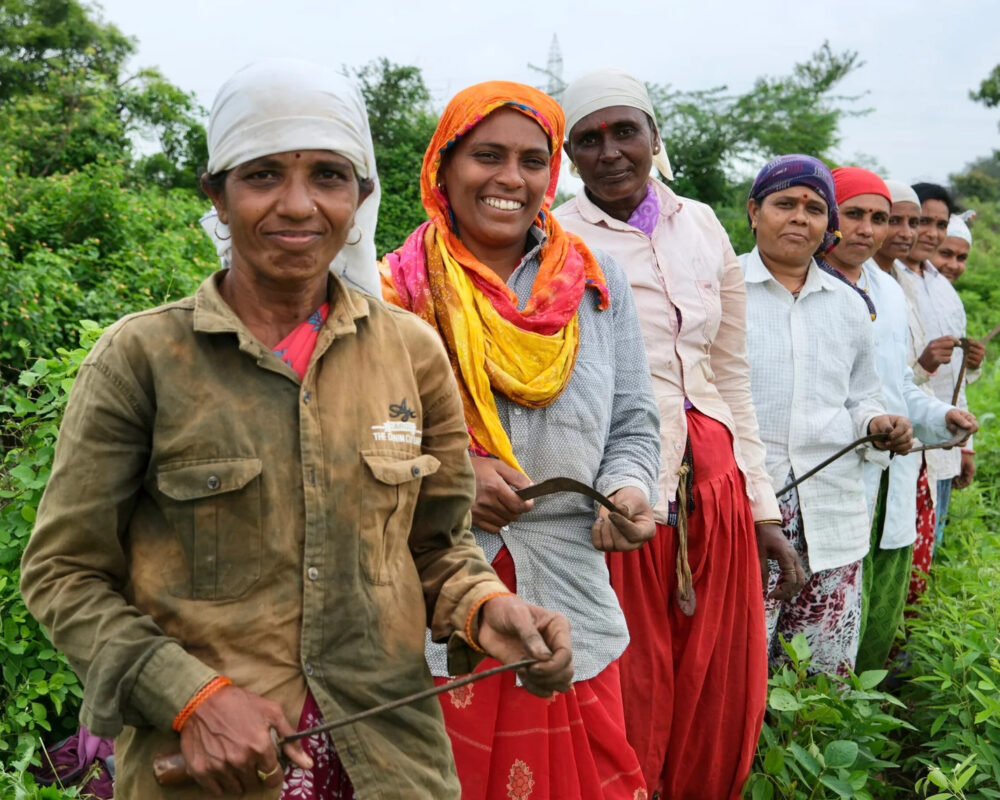
“Eyewash” is used as an idiom in the English language to mean tricking people or creating a false impression. This is exactly what the BJP-led Maharashtra state government has done on 1 July 2026 by adopting the Maharashtra Women Farmers Empowerment (MWFE) Bill 2026. The unique step in this Act is the recognition of women farmers, workers, tenants, livestock farmers, and fishers, yet without addressing the crucial issue of their land ownership!
Recognition Without Land Rights: The MWFE Act’s Fundamental Contradiction
The MWFE Act 2026 addresses some major issues of women farmers for the first time in India. Recognising women farmers is highly important politically in contemporary India due to the growing feminisation of agriculture amid the unbridled rural-to-urban distress migration of male workers due to the acute lingering agrarian crisis. Women now account for more than 42% per cent of the country’s agricultural workforce (PLFS 2024). Of working women, 60.6% are in agriculture. In Maharashtra, about 88% of rural women are engaged in agriculture and agriculture-related work.
However, the million-dollar question still remains. Will the “Women Farmer Certificate” stipulated by the MWFE Act 2026 resolve the crisis of farming in Maharashtra? Or is it a recognition certificate for women farmers to access distress farming due to faulty state policy? This is a concrete class question requiring a concrete political solution with urgent remedial measures from all the state governments and the Union Government.
If the Devendra Fadnavis government was sincere about the “welfare” of women farmers, it would have addressed the most appalling consequence of its policy failure: the fact that his state tops in farmers’ suicides due to indebtedness. According to NCRB data for 2023, about one out of every two farmer suicides in the country occurred in Maharashtra. In the first three months of 2025 alone, 767 suicides were recorded in the State – at least one every three hours. In the first nine months, the figure reached 781; 296 were in the Nagpur division and 212 in Aurangabad division. The cotton belt of Vidarbha and Marathwada regions of Maharashtra is prone to the largest number of suicides and resultant suffering of women farmers.
When her male counterpart with a right and access to land failed, and was forced to opt for either distress out-migration or death by suicide, will the recognition certificate (without land ownership rights) bring success to a women farmer? The answer is an emphatic NO. The MWFE Act 2026 is not expected to check recurring peasant suicides in Maharashtra, as the law has brought no structural change in the present crisis-ridden agriculture.
Agrarian Crisis, Land Reforms and the Feminisation of Agriculture
There is no shortcut to save women farmers across India other than addressing the unfulfilled tasks of a comprehensive agrarian revolution. This requires radical land reforms, ensuring access to means of production including land, restructuring land relations under producer cooperatives, transcending petty production to large-scale production, preventing corporate entry into agriculture, ending market exploitation, and developing agro-based industrialisation and market networks.
The land holding pattern in Maharashtra – akin to other states – has been heavily marked by progressive fragmentation and shrinking farm sizes over the last few decades. According to the latest available data from the Economic Survey of Maharashtra 2025-26, the total number of operational holdings in the state stands at approximately 171.11 lakh, with a record low average holding size of just 1.23 hectares. The land fragmentation crisis is most visible in regions like Vidarbha and Marathwada. In Vidarbha, more than 86% of the 45 lakh farmers have dropped into the small and marginal brackets, having their average land holding lower than the state’s baseline at roughly 1.08 hectares.
Farming on leased land is an expanding trend in rural Maharashtra. Recent data reveals that roughly 16% of agricultural households now operate leased land, signalling a transition from pure direct owner-cultivator systems to functional tenancy networks.
After independence, in the context of various enactments related to land, the formal legal framework of feudal land ownership is no longer in place and land ownership and possession are primarily governed and regulated by state governments playing a role in land administration and revenue collection all over India. However, the legacy and lingering effects of landlordism, including substantial concentration of land, concealed tenancy, widespread landlessness and inequalities continue to exist in large parts of India.
Hence the demand to implement all existing land reform laws, such as those on tenancy rights, ceiling surplus land, pasture land, bhoodan land, benami land, temple land, etc in their true spirit is highly important. The progressive peasant movement has to build massive local struggles to force state governments to identify and redistribute all such lands to the landless peasantry and marginalised communities with equal rights for women farmers.
Collective Farming, Democratic Alternatives and the Way Forward
As far as the small and middle peasantry is concerned, in the face of continuous denial of remunerative minimum support price and minimum wage to agrarian classes, alternative policies such as promoting producer and consumer cooperative and collective farming systems for agriculture-led growth under the aegis of the state, are necessary to protect their livelihood. The MWFE Act 2026 is unwilling to address such a fundamental restructuring of land relations.
Collective and cooperative agriculture will enable petty producers to advance toward a higher phase of agricultural modernisation on democratic and sustainable terms, reduce costs, increase production and productivity manifold based on scientific and technological advances. They need support through backward and forward linkages for input industries, large-scale crop based modern agro-processing industries and branded marketing networks.
The public investment required for this major agrarian task needs credit support from financial institutions in the public and cooperative sectors. Increasing the share of the Divisible Pool from the current 31% (including cess and surcharge) to 50% and restoring the states’ taxation power by amending the GST (Goods and Services Tax Act 2017) thus become non-negotiable.
Agriculture and agro-processing sectors must remain outside the reach of foreign and domestic corporate sectors to protect the peasantry. Appropriate statutory revenue sharing models must be developed to share the surplus produced from processing and marketing agro-produce in cooperatives as well as in the non-monopoly private sector with primary producers. The Union and state governments need to enact laws for remunerative MSP with guaranteed procurement of all crops and minimum wage. The Fadnavis-led BJP government is not ready to address these tasks in the MWFE Act 2026.
Demanding democratic alternatives, prioritising collective decision-making and discarding bureaucratic supremacy can rally the peasantry in a mass resistance movement to preclude exploitative, corporate policies including the Free Trade Agreements that allow the corporate takeover of agriculture. However, the council and the monitoring committee in the MWFE Act do not permit decision-making power and representation of women farmers.
Self-critically speaking, the progressive Kisan movement has so far failed to raise the women farmers’ issue with concrete demands made to respective governments. The progressive Kisan movement must demand that all state governments recognise women farmers by law, ensuring their right to land and means of production – including credit, subsidies, market access, agro-processing, value addition, research and development, and sharing of surplus from value addition. As a prerequisite, we need to ensure equal participation in the farmers’ movement’s organisational structure. This will enable constructive democratic changes and mass strength for the progressive Kisan movement, which is essential to end the pauperisation, exploitation, and suffering, especially of women peasants, and overcome the acute agrarian crisis.