Magazine
Adivasi Adhikar Rashtriya Manch (AARM) National Convention: Resolves to Intensify the Struggle for Land, Forest, and Dignity
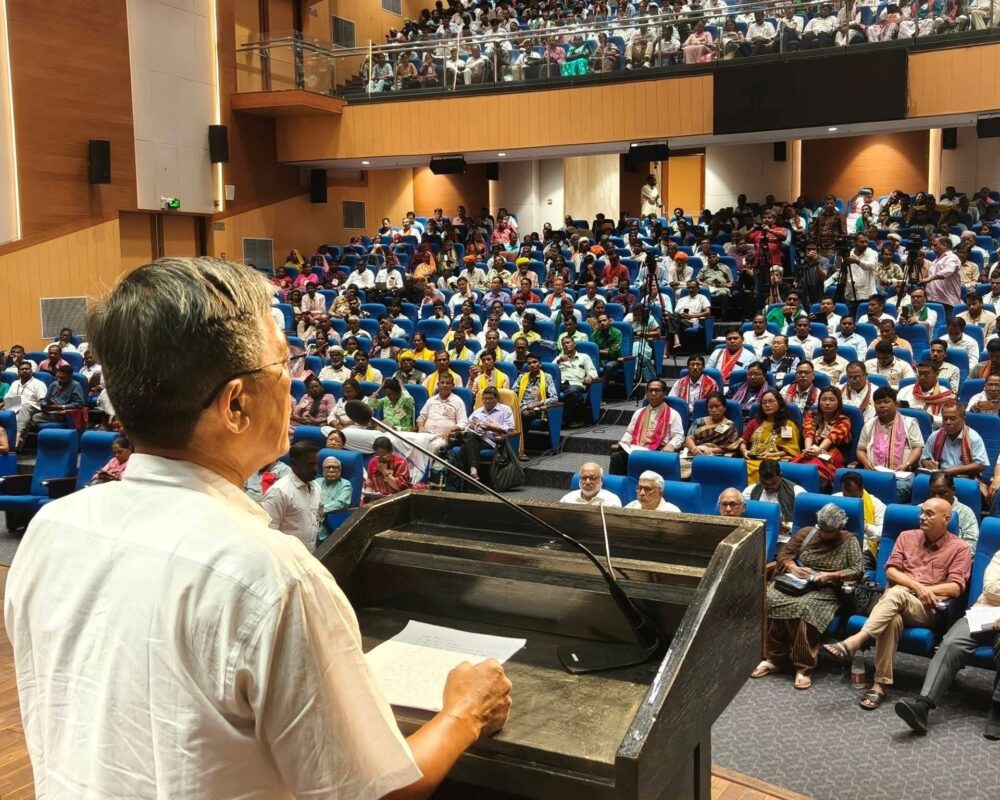
On 6 September 2026 the Mavlankar Hall near the Constitution Club in New Delhi resonated with the songs and slogans of resistance. A portrait of the legendary Adivasi freedom fighter Birsa Munda loomed over the 1,100 tribal delegates from 16 states who had gathered under the banner of the Adivasi Adhikar Rashtriya Manch (AARM). The AARM National Convention was an assertion that the battle for Jal, Jangal and Jameen still remains the unfinished agenda of Indian democracy. The next day’s AARM march from Shaheed Bhagat Singh Park took that assertion into the streets of the capital.
The Spirit of Birsa Munda
The AARM organises tribals around their rights, unites their struggles, and brings their demands into the broader democratic and class movements of the country. This convention brought out the challenges before the Adivasi community and the task of building a powerful alliance of Adivasi peasants, workers, women, students, youth, employees, and others.
For generations, Adivasi communities have protected forests, cultivated land, preserved water, and sustained rural economies. Yet, they have been dispossessed of their resources, denied secure land rights and pushed to the margins of development. Their fight against displacement, for forest rights, and for dignified livelihoods is inseparable from the larger agrarian struggle. Any attack on Adivasi rights is an attack on the democratic rights of rural India itself. The presence of leaders of AIKS, AIAWU, CITU, AIDWA, SFI, DYFI, Bharat Jan Andolan, Campaign for Survival & Dignity, and other organisations stressed this organic unity.
AARM National Convenor Pulin Baski made the welcome speech. AARM National Chairperson Jitendra Choudhary in his introduction made a succinct analysis of the all-round attacks on Adivasis which have been launched by the Modi-led BJP-RSS union government and their state governments over the last dozen years, and called for strengthening our resistance at all levels.
The convention was inaugurated by former Supreme Court Justice Madan Lokur. He spoke with the quiet authority of one who has opposed constitutional promises being eroded. He said that the Fifth and Sixth Schedules, the Forest Rights Act of 2006 and the Panchayats (Extension to Scheduled Areas) Act (PESA) of 1996 remain poorly implemented even decades after their enactment. Gram Sabhas are bypassed at will. Police cases are filed against Adivasis who assert their rights. Education and employment opportunities for tribals are shrinking. His reference to teenage Adivasi girls working under abysmal conditions as domestic workers in metropolitan cities brought the human cost of dispossession into sharp focus.
Jal Jangal Jameen: Foundation of Adivasi Existence
The Adivasi question cannot be understood merely as a question of welfare, reservations or the distribution of government benefits. At its heart is the question of control over productive resources. Who owns the land? Who controls the forests? Who decides how minerals are extracted? Who benefits from development? And who bears the cost when villages are displaced? For Adivasis, Jal Jangal Jameen are not abstract slogans. They represent food, shelter, livelihood, culture, social identity, and the freedom to determine their own future.
The historical dispossession of Adivasis has taken many forms: the seizure of cultivated land, the alienation of community resources, restrictions on forest use, displacement by dams and mines, and the exploitation of forest produce by traders and contractors. British colonial forest policies transformed forests from community life-support systems into sources of commercial revenue. Independent India inherited these structures, and capitalist development has deepened the conflict between corporate interests and the rights of forest-dependent people. The convention’s significance lay in bringing all these questions together in national focus.
Four thematic sessions – on forest rights, employment, education, and identity were held in this convention. Nearly 60 speakers rose from the floor with experiences that came from the length and breadth of the country: the struggles in Hasdeo Arand in Chhattisgarh, the Ken-Betwa project in Madhya Pradesh, the Nagarhole Tiger Reserve in Karnataka, the Polavaram project in Andhra Pradesh, the Kumram Bheem Conservation Reserve in Telangana, and the huge battles for vesting of forest land in Maharashtra, Jharkhand, Odisha and the North-East.
Undermining Forest Rights
The session on forest rights, introduced by Smita Gupta of the Centre for Adivasi Research and Development, laid bare a structural crisis. The Forest Rights Act (FRA) 2006 was a historic recognition that forest-dwelling Scheduled Tribes and other traditional forest dwellers possess rights that had long been denied. It recognises individual forest rights, community forest resource rights, and rights connected with habitation, livelihood and customary use.
But the FRA itself has been undermined. Official figures show that by 2026 only 47 per cent of claims had been approved, while 33 per cent had been rejected, including nearly 48,000 community claims. Rejections occurred because of absence of documents like written land records, satellite maps, etc. which the law never required. Titles, when granted, cover much less land than claimed. The hostile Forest Department still continues to dominate a process that the Act had placed in the hands of the Adivasi Welfare Department and the Gram Sabhas.
Land Alienation and Corporate Assault
The Van Sanrakshan Adhiniyam of 2023 narrowed the definition of ‘forest’ and exempted security, infrastructure and eco-tourism projects from standard clearance regimes and Gram Sabha consent. Environmental impact assessment rules have been rewritten to reduce public hearings. The Samatha Judgment of 1997, which barred transfer of Scheduled Area land to private companies for mining, is routinely bypassed through joint ventures and mine developer contracts routed via state public sector undertakings. Hasdeo’s four lakh felled trees, the false Gram Sabha minutes in Santhal Parganas, the threatened eviction of 339 villages in Telangana, all testify to a systematic subversion of law. The Project Tiger has displaced an estimated 5.5 lakh people since 1973, with 2.9 lakh of them concentrated in just six reserves notified after 2021. The FRA and the Wildlife Protection Act (WPA) both require settled rights and informed consent. In practice, consent is extracted through attrition.
Land is the principal productive resource for millions of Adivasi families. Its loss means more than the loss of property. It means the destruction of food security, employment, community life, and the possibility of passing a livelihood to the next generation. Land alienation takes place through illegal transfers, indebtedness, coercion, manipulation of records, fraudulent transactions and displacement for infrastructure, mining or industrial projects. Even where protective laws exist, enforcement is often weak. The affected family faces a powerful combination of officials, contractors, moneylenders and private interests.
Attacks on PESA and the Power of the Gram Sabha
The Panchayats (Extension to Scheduled Areas) Act, 1996, was intended to strengthen self-governance in Scheduled Areas. It recognises the importance of Gram Sabhas in protecting community traditions, managing resources and participating in decisions concerning local development. This Act is being systematically subverted.
The Gram Sabha cannot become a symbolic institution that is consulted only after decisions have already been made. Its authority must be respected in accordance with law. Adivasi communities must have a meaningful voice in decisions concerning land acquisition, mining, displacement, forest resources and local development. It is also a question of control over the resources upon which agricultural production depends. The struggle for Gram Sabha rights must therefore be linked with the struggle against governmental domination, corporate land grabs and the privatisation of common resources.
Adivasi Women: The Backbone of Rural Survival
No discussion of Adivasi rights can be complete without recognising the central role of women. Adivasi women participate in cultivation, collection of minor forest produce, agricultural labour, livestock care, water collection, household work and the preservation of community knowledge. They sustain rural production, yet their contribution is frequently unrecognised in official records and economic calculations.
Women also face particular forms of deprivation. The loss of forests increases the distance they must travel for fuel, water and forest produce. Displacement destroys social support networks and exposes women to greater economic insecurity. Inadequate healthcare, malnutrition, lack of educational and employment opportunities, and violence against women further deepen their vulnerability.
Adivasi women must not be treated merely as beneficiaries of welfare schemes. They must be developed as leaders and decision-makers. Adivasi women’s participation strengthens the entire movement. Their struggles connect land and forest rights with questions of patriarchy, class exploitation and equality.
Employment: Quiet Erosion of Reservation
The employment paper placed by Duli Chand revealed another front of exclusion. Government employment has shrunk from around 2 crore posts in the 1990s to 1.7 crore by 2012, with further decline thereafter. Within this shrinking pool, posts remain unfilled. Central vacancies nearly doubled between 2014 and 2024. In nine ministries alone, over 12,000 posts reserved for Scheduled Tribes lay vacant in 2023. ST representation among central government employees fell from 8.55 per cent in 2014 to 7.33 per cent by 2022. Of the 87 secretaries to the Government of India, only a handful belong to SC or ST categories. Privatisation further shrinks the sphere where reservation applies.
The government has stopped publishing comprehensive employment reviews, making the data harder to scrutinise. MGNREGA, which once provided a statutory guarantee that reached Adivasi households, has been scrapped. The VB-GRAM-G, implemented from 1 July 2026, is nothing but an unemployment guarantee scheme.
Education: Schools Closing, Futures Denied
The education paper presented by Ram Narain Kuraria painted an equally stark picture. More than 79,000 schools have closed since 2018-19, almost all of them government schools, under the banner of “rationalisation.” Schools run by Tribal Welfare Departments have fallen from about 70,000 to under 40,000. Of the more than 700 promised Eklavya Model Residential Schools, only 511 function. Dropouts have risen. Higher education remains a distant dream.
Remote villages often face shortages of teachers, healthcare personnel, transport and educational infrastructure. Students may have to travel long distances to attend secondary schools or colleges. Language barriers and the weakening of education in the mother-tongue further alienate children from formal education. For families already facing economic hardship, education becomes an additional financial burden. Conditions in existing ashram schools and hostels are often appalling: many girls sharing a single bed, unhygienic water, closed sick rooms, and hundreds of student deaths directly linked to neglect.
Identity Under Assault
The final session on identity, placed by Suknath Lohra brought the cultural and political dimensions into focus. Criteria for Scheduled Tribe classification still rest on the outdated Lokur Committee recommendations of 1965. There are attempts to dilute recognition by pushing non-Adivasi claims and introducing a religious criterion that would delist converts.
AARM firmly rejects any religious test for ST status. It demands that classification criteria be freed from political manipulation, that Adivasi languages be included in the Eighth Schedule, and that Adivasi faiths receive proper recognition in the Census. The fight is not only for land and jobs but for the right to be distinct peoples with their histories, languages and traditions.
Summing Up: Charter of Demands
Brinda Karat, in her concluding speech said that displacement is the biggest attack on Adivasis. It not just uproots Adivasis from their land, it robs them of their existence and identity. With no proper rehabilitation, they are deprived of basic human rights. The BJP-RSS government is hell bent on weakening all protective laws to help its corporate friends. We have to combat its devious attempts to divide Adivasis in the name of religion. Jal Jangal Jameen belongs to the Adivasis and no one can snatch it from them.
The convention adopted a comprehensive Charter of Demands. On forest rights: time-bound review of rejected claims, genuine empowerment of Gram Sabhas, freeze on forest evictions, participation of Adivasi women in the management of community resources. On employment: reservation in proportion to population, filling of all backlog vacancies, and an end to privatisation that dilutes quotas. On education: increased budgets, better hostels and scholarships, digital access and education in mother-tongue. On constitutional protection: expansion of Fifth Schedule areas and full implementation of PESA. On identity: protection of ST classification from political games and recognition of Adivasi languages and faiths.
The convention also called for reform within customary laws that perpetuate patriarchy, recognising that the struggle for Adivasi rights must also be a struggle for equality.
Struggle Call: Adivasis and Peasants
Adivasi peasants and agricultural workers are among the most exploited sections of the rural population. Their land is coveted by the corporates for mining and infrastructure. The government-corporate war on Jal Jangal Jameen is a war on the peasantry itself. Adivasi cultivators face the same problems as other small and marginal peasants: rising input costs, lack of remunerative prices, indebtedness, inadequate irrigation, insecure markets, and the erosion of public investment. At the same time, they face specific forms of oppression arising from their historical marginalisation, forest dependence and land alienation. A united movement must recognise both dimensions. The AIKS, AIAWU and AARM must work together on these common issues to fight the BJP-RSS regimes and build a stronger movement.
The clarion call for struggle must now be carried into every village, forest, school, college, hostel, workplace, and Gram Sabha. The unity between Adivasi organisations, peasants, workers, agricultural labourers, women, youth and students must be deepened. The AARM’s National Convention underlined that the struggle for social justice cannot be separated from the struggle for control over land, forests and natural resources. Long live Adivasi–Kisan unity!