Magazine
Mass Campaign against Electricity Privatisation in Haryana
Even as the All India Kisan Sabha (AIKS) and the Samyukta Kisan Morcha (SKM) are striving hard for withdrawal of the Electricity Amendment Bill 2025, some state governments are trying to privatise this crucial sector at full pace. It may be recalled that, at the end of the historic and victorious year-long SKM-led struggle against the three Farm Laws, the Union Government had promised in a written communication dated 9 December 2021 to the SKM that it would take all stakeholders into confidence before introducing the disputed Electricity Amendment Bill in Parliament. But the Modi regime backed out from honouring other promises it had made. Tabling of the Electricity Bill in Parliament was one such instance of deceit, among others.
The modus operandi being adopted in this regard is doing it through the back door. State governments are embarking on privatisation of the power sector in various ways like handing over the distribution licenses to private companies at the cost of the public sector, en masse installation of smart meters, and so on. Such moves have been successfully thwarted by mass protests in Uttar Pradesh, Karnataka, Telangana etc during recent months.
Two Bizarre Decisions
The double engine government of Haryana has arbitrarily taken two bizarre decisions towards privatisation of the power sector. One, setting up a third company named Haryana Agri Discom, besides Uttar Haryana Bijli Vitaran Nigam (UHBVN) and Dakshin Haryana Bijli Vitaran Nigam (DHBVN). These two companies were set up during the 1990s following the winding up of the State Electricity Boards. The second is the creation of a parallel power distribution system for the two districts of Gurugram and Nuh by inviting applications from private companies for the purpose of electricity distribution.
The decision of creating Haryana Agro Discom (Agriculture Distribution Company) is aimed at segregating power distribution to the agriculture sector from other sectors in the first phase. Under the lucrative promise of making regular and quality power supply to agriculture, what is offered is supply by the solar method which cannot generate power during the night and also in cloudy weather. The proposed segregation of the agriculture sector will ultimately do away with the cross subsidy – a fact which even the government notification has not considered necessary to hide from the public. The new company to be entrusted with this task has a debt to the tune of over Rs 6,000 crore. It is bound to be declared bankrupt quite soon, leaving farmers to fend for themselves to buy electricity from private entities at exorbitant cost.
Solar panels and other accessories do not have an indefinite life. The hidden agenda in this nefarious game is to minimise the opposition to other steps like smart meters and enhancement of power tariffs. Around 10 lakh old meters have already been replaced, particularly in bigger cities like Faridabad, Gurugram, Karnal etc with newly devised meters which can easily be switched over to smart meters within no time.
Building Broad Platform for Resistance
It is in this background that an important extended meeting of representatives of AIKS, AIAWU, CITU, Sarva Karamchari Sangh, Women, Students, Youth and others was organised at the invitation of Power Workers Union and Power Engineers Association on 7 June 2026.
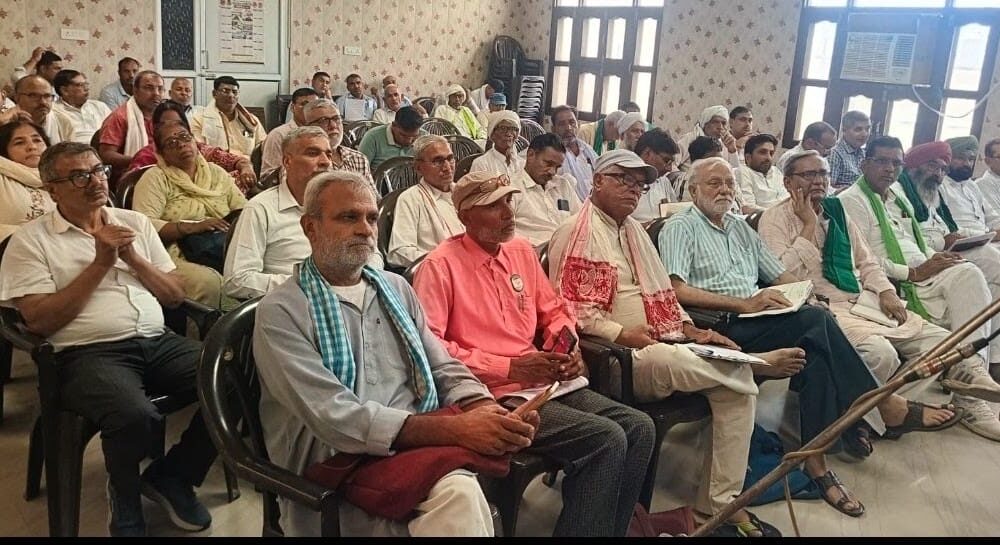
It was decided to make it a broadest possible platform of power consumers comprising other Trade Unions, Employees Unions, Farmers organisations and others in order to chalk out a call of action towards stalling the proposed privatisation drive in all its forms. For this purpose another larger state level meeting was held at Rohtak on 14 July. The meeting was held at the invitation of all the four major Electricity Employees Unions and Engineers Associations. The well-attended meeting comprised representatives of the main constituents of the Haryana SKM including the AIKS. Other organisations like CITU, AIAWU, AIDWA, Sarva Karamchari Sangh also took part and resolved to unitedly fight against the privatisation drive of the well-performing public power sector in Haryana. Leaders of the Electricity Employees Federation of India (EEFI) explained in detail the disastrous consequences of power privatisation being carried out under the cover of “reforms”.
In the meanwhile, the Haryana Electricity Regulatory Commission (HERC) invited suggestions/objections from the public regarding application of a private company named Eleven Power Pvt Ltd for a licence to a parallel distribution system for Nuh and Gurugram revenue districts.
In response to the declaration of the above public hearing, the Haryana AIKS also filed a representation as intervener in this case before HERC along with the CPI(M) state committee, Power Workers Union and others, including a former Haryana minister and INLD leader Prof Sampat Singh. A public hearing for the petitioners, the respondents and the interveners was held at the HERC headquarters at Panchkula on 8 July.
Electricity is Survival Necessity, Not Profit-Making Venture
A pointwise pro-people perspective was presented emphasising that just like education, water supply and health etc, electricity was a survival necessity for all sections of society and it cannot be treated as a profit-making venture. It was unacceptable to hand it over to the private sector for extorting profits from the people for whom it was created solely with the investment by the public exchequer. The applicant company had brought a herd of hired lawyers and other managed supporters to impress the Commission.
Sumit Singh appeared on behalf of the Haryana AIKS before the Commission and presented pointwise arguments against the privatisation bid. On completion of the hearing the Commission constituted a panel of three experts to make a thorough assessment of the impacts arising out of the parallel distribution system and submit its report within two weeks which will be recommendatory in nature. There are little chances of any substantial relief from this Committee comprising so-called experts.
In the meanwhile, Adani has also submitted another application to get a licence for the parallel distribution system in the Nuh and Gurugram revenue districts. According to reports Faridabad and Panchkula districts are also tipped for private parallel distribution system in the next round.
After a detailed discussion, the 14 July Rohtak meeting came to the conclusion that it was imperative to have a powerful mass movement to contain and stall the privatisation. Therefore, a joint platform named Bijli Karamchari evam Upabhokta Sangharsh Manch was set up. It was decided to organise big public protests at Nuh and Gurugram on 21 and 22 July respectively, followed by district level joint conventions by 10 August to coincide with the All-India protest by SKM and CTUs to mark the 1942 Quit India Movement anniversary.
Those who addressed the meeting included Subhash Lamba, Devender Hooda, Suresh Rathee, Anil Kaushik, Bijender, Inderjit Singh, Rattan Maan, Jogender Nain, Mukesh, Rajender Chhokar and others. It was resolutely decided that the United Manch will fight simultaneously on the roads as well as in the courts of law.