Magazine
AIKS CKC Meet at Mumbai Gives Call to Unleash Large Peasant Struggles
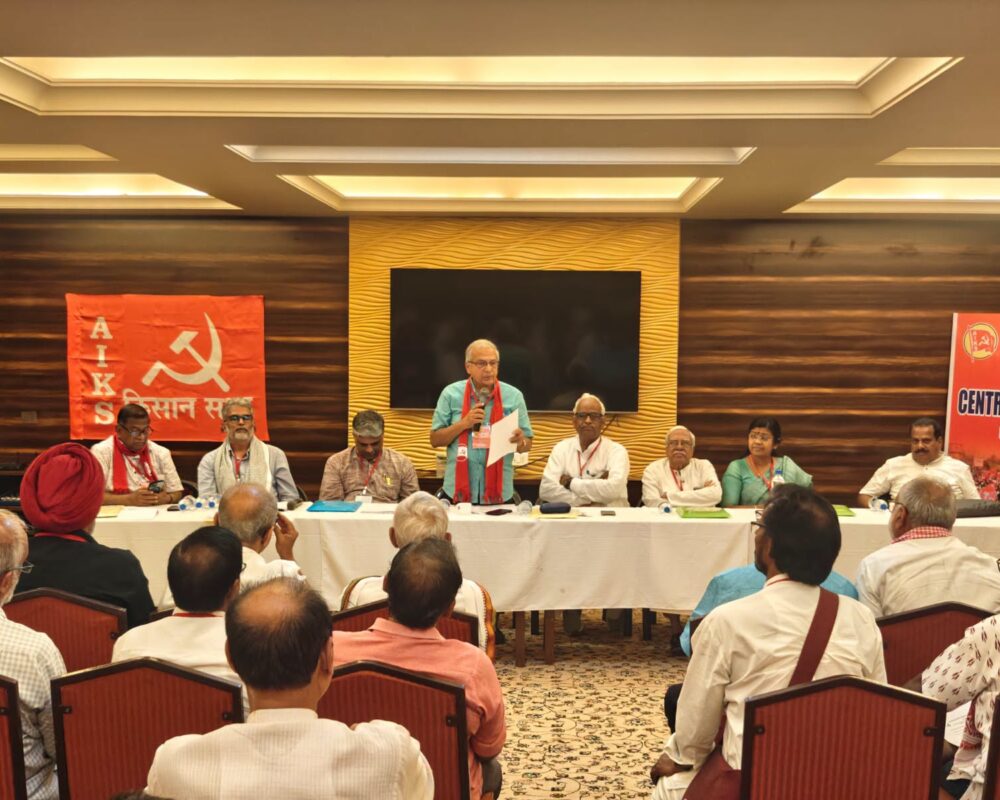
The AIKS Central Kisan Committee meeting held in Mumbai on 28-29 June 2026 called for advancing independent struggles towards peasant unity and streamlining united struggles to consolidate the growing worker-peasant unity against the twin dangers of corporate class rule and communal forces until their crucial demands are achieved. These struggles are central to rallying the working people across India under the slogan “Save India-Save Agriculture”.
It was the second time that the city of Mumbai hosted the CKC meeting, the first time being long back in 1942. The top leaders of India’s largest kisan movement were warmly welcomed. On the last day, 30 June, CKC members enjoyed the Mumbai Darshan bus tour in rain.
The meeting began with the flag hoisting by AIKS President Dr Ashok Dhawale, followed by floral tributes to martyrs. The condolence resolution was placed by CKC member Manoj Kumar. The welcome address was delivered by CITU state vice president Dr S K Rege, chairperson of the reception committee, by recalling the historic contribution of Mumbai and Maharashtra to the freedom struggle, and the working class and peasant movements.
Dr R Ramakumar presented to the AIKS a beautiful line drawing by the legendary artist Chittaprasad of the mandap of the first Maharashtra State Conference of the AIKS which was held at Titwala in Thane district on January 7, 1945. Former President of the Maharashtra Federation of University and College Teachers Organisations (MFUCTO) Prof Tapati Mukhopadhyay and former Vice President of the Bank Employees Federation of India (BEFI) G M V Nayak greeted the inaugural session.
Presidential Address
In his presidential address, Dr Ashok Dhawale denounced US imperialism and Israeli Zionism for its unilateral war on Iran, and hailed Iran’s valiant fightback. He also condemned Israel for its demonic genocide of children, which has now been clearly documented in a Report of a United Nations Commission which was headed by an eminent jurist Srinivasan Muralidhar.
The corporate-communal RSS-BJP regime is unleashing an all-round attack on the entire working people. For the last 12 years, Modi has continuously betrayed the entire peasantry by denying the promise of a legal guarantee for remunerative Minimum Support Price (MSP) @ C2+50%, refused to cut spiralling input costs in farming, and refused to give a complete central loan waiver to millions of poor and middle peasants, tenant farmers and agricultural workers, while shamelessly writing off corporate loans worth Rs 16.35 lakh crore.
The Modi regime has implemented the most regressive anti-worker four Labour Codes that literally enslave workers to the capitalist order and has repealed the MGNREGA. It has accelerated privatisation of power through the Electricity Amendment Bill and smart meters and introduced a dangerous Seed Bill. On top of all this, it is imposing the anti-national US-India Free Trade Deal and other FTAs – succumbing to US imperialist pressure. This is a grave assault not only on millions of peasants and workers, but also on lakhs of MSMEs.
But the most serious assault of the RSS-BJP-led regime is on democracy, secularism, and the Constitution itself, through the Central Agencies, the kept Media, the servile Election Commission, SIR, and delimitation, and splitting and poaching upon the opposition parties.
The Address concluded by saying that the resulting economic and social distress has yet to translate into unified and generalised resistance. This is the challenge for the progressive kisan and working-class movement in India. Struggles, organisation, imagination, credibility and determination are indispensable, since social suffering alone does not automatically create progressive politics. Launching massive struggles, leading the ideological battle, and building a steely organisation from the grassroots is crucial for any radical social transformation.
General Secretary’s Report
The General Secretary’s report detailed the growing international and national contradictions. The global crisis of capitalism continues and growth estimates show a clear downward trend. According to the World Bank’s Report of June 2026, global growth is set to slow further from 2.9 percent in 2025 to 2.5 percent in 2026. Clearly, the crisis is deepening and major capitalist countries face stagnation or recession.
The real wages have declined in most G20 countries. The number of workers living in extreme poverty is growing along with unemployment. The World Inequality Report 2026 stated that the global financial system reinforces inequality. The top 0.001 percent of the global population (fewer than 60,000 multi-millionaires) now owns more wealth than the entire bottom half. The global top 10 percent owns three-quarters of all wealth while the bottom half owns just 2 percent. This trend widens the economic divide between rich and poor countries.
But across the globe, there have been massive protests and resistance by the working people to austerity measures and anti-worker labour reforms.
The US war on Iran adversely impacted the global economy and affected people’s cost of living. Most countries experienced shortages of LPG, fertilizers, diesel, petrol and food. The hegemony of the USA is being resisted by the people of the European Union as well. The fierce resistance offered by Iran with covert help from China and Russia, changed the trajectory of the “asymmetric” war, and US imperialism was forced to sign a “peace” treaty.
India also witnessed a similar widening of inequality between the miniscule rich sections and the vast majority of the working people. According to the Oxfam report, the richest 1 percent own 40 percent of the wealth, and the bottom 50 percent own only 3 percent. In 2019, the combined wealth of India’s billionaires was Rs. 31 lakh crores. By 2025, it has increased to Rs. 88 lakh crores.
Given the unchecked increase in the price of inputs and unremunerative prices for farm produce, indebtedness and farm suicides are rising. On an average, 7 suicides daily are recorded in the Vidarbha and Marathwada regions of Maharashtra alone. Agrarian distress has forced many rural people into migration to urban areas. According to the report by ‘The Wire’, approximately 173.4 workers (comprising daily wage earners, agricultural labourers and cultivators) died by suicide every day in India in 2024 compared to 77.2 deaths per day in 2014.
Through the FTAs, the ruling class is rolling out the red carpet for Multinational Corporations with promises of unrestricted market access, unbridled profits and absolute disregard for the lives and livelihoods of millions of peasants and agricultural workers in India. The FTAs are the blueprint for the economic colonisation of India.
The successful General Strike on 12 February 2026 was a major joint effort by the workers and peasants to resist this policy onslaught. The recent period witnessed massive protests by the contract workers and unorganised sector workers especially in the industrial regions of North India. These spontaneous upsurges created great enthusiasm among workers across the country.
The meeting self-critically evaluated the setback recently suffered by the Left and Democratic forces in Kerala and in the other five states where state assembly elections were held. In West Bengal, the BJP forming the state government is very dangerous and the working people will have to face large scale attacks. These results have emboldened the corporate classes and the latest onslaught is the duopoly of Adani and Leap India in the FCI silos, where 77.5% of the grains will be controlled by them.
The BJP as well as the ruling class political parties in the opposition are continuously neglecting the class demands including MSP, wages, land, employment, education, health, pension, housing etc. The sparring interests of different classes reflect as internal conflicts and contradictions within the INDIA bloc also. Considering such intensifying contradictions, building Left and democratic unity is inevitable, while safeguarding the larger unity of the secular and democratic forces.
Hence rallying the peasantry and the working class on the struggle path across India has great political importance now. Building a Left and Democratic Alternative and reviving the National Platform of Mass Organisations (NPMO), which has a glorious past of rallying millions of toilers against neo-liberal policies are inevitable.
Five years have passed since the historic SKM-led farmers’ struggle of 2020-21, which sacrificed the lives of 736 martyrs and lasted for 380 days of mass protest. While the BJP-RSS Modi regime was forced to surrender and repeal the three Farm Laws, it did not fulfil the written assurance of MSP@C2+50% and loan waiver. Instead, further attacks via FTAs, Labour Codes, Repeal of MGNREGA, the curtailing of NFSA, large-scale land grab, suppression of democratic rights of protest, attacks on freedom of expression, communal violence, corruption etc. have sparked great anger and wrath among the working people.
The task ahead is to reach out to the peasant masses in villages and prepare them for a long haul of struggles. It is crucial that AIKS, CITU and AIAWU collectively develop regular coordination at state and district levels and consolidate worker-peasant unity up to the villages and towns. AIKS units must be sensitive enough to prioritize this task, hold annual planning and review and realise worker-peasant unity across India at any cost, without which the peasantry and the working-class masses cannot advance to radical social transformation.
Decisions of the Mumbai CKC Meeting
The meeting endorsed the proposals of the All-India Convention of the SKM on 28 July and the National Convention of Workers and Farmers on 29 July at Talkatora Stadium, New Delhi. The nationwide call on 10 August 2026 for mass protest action including Jail Bharo, Rail Roko, and Road Roko will mark the beginning of a new wave of resistance to the brutal wave of corporate exploitation.
The call for independent struggles on policy demands as well as on pressing local demands will enable AIKS consolidation and will help forge the broadest unity among the peasantry, workers, agricultural workers and all other sections – including students, youth, women, petty traders, micro, small and medium entrepreneurs, Adivasis, Dalits, Minorities—suffering the brunt of the corporate-communal onslaught.
The CKC meeting also took the important decision to hold the 36th AIKS All India Conference at Nalgonda, Telangana from 18-21 November 2026. Nalgonda was one of the epicentres of the iconic Telangana People’s Struggle led by the AIKS for five years from 1946-51.
The Mumbai CKC meeting of the AIKS will be marked in the history of the Kisan movement for giving the direction for consolidating the organisation and advancing independent as well as united struggles based on worker-peasant unity to end the corporate-communal rule.