Magazine
Ayodhya Ram Mandir Donation Dacoity
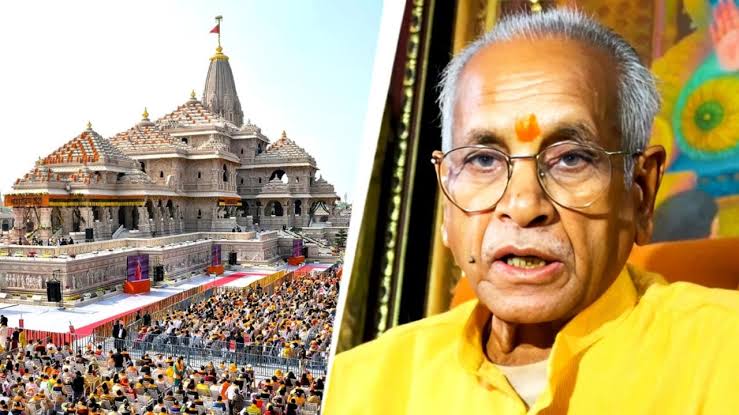
The scale and magnitude of the looting of offerings at the Ram Temple—the towering pillar of the Modi-RSS political project standing in Ayodhya—are both enormous. Initially, the amount siphoned off was reported to be over ₹ 200 crore. It has now become clear that the actual value is several times higher. This is because the theft involves not only the currency notes allegedly removed from the donation boxes that receive daily offerings, but also the gold, silver, diamond, and ashtadhatu (eight-metal alloy) slabs that had been donated from the very beginning of the Ram Temple campaign until after the temple’s completion. These, too, are now reported to be missing. Some of these slabs were inlaid with diamonds, pearls, and rubies. Their number alone is said to be around 1,250. These were not merely gold coins or sovereigns but gold bricks and plaques. Naturally, their actual value would run into many hundreds of crores of rupees.
India’s former Union Home Secretary himself had donated a one-and-a-half quintal (150 kg) Ramayana, containing nearly 5 kg of gold; that too has reportedly disappeared. The garland placed on the idol of Ram and even the sacred sandals (padukas) have allegedly been stolen. Nripendra Misra, a member of the Ram Temple Trust constituted by Narendra Modi and the man in charge of the temple’s construction, as well as the former Principal Secretary to the Prime Minister, reportedly considers this not merely a theft but a dacoity.
Eerie 1000 Year Gap – Ghazni and Somnath, Modi and Ayodhya
Much has already been written about the financial magnitude of this dacoity, and much more is likely to emerge in the coming days. The affair is so massive that even the courtier and “godi” media have been compelled to report on it. Therefore, there is little need to elaborate further here. It is enough to say that, by any measure, this plunder is no less significant than the one that took place exactly a thousand years ago. In 1026 CE, Mahmud of Ghazni looted the Somnath Temple and carried away immense quantities of gold, silver, wealth, and treasure. The scale of the loot from the Ayodhya Ram Temple, exposed in 2026, is no less—and in several respects, even greater.
There are, however, two important and fundamental differences between the two incidents. The first is that Somnath was looted by an invader; in Ayodhya, the watchman (chowkidar) himself is alleged to have become the thief.
The second difference is even more serious: Mahmud looted a temple, not a religion. Even had he wanted to, he could not have attacked the religion itself, because a section of his own military commanders were Hindus who continued to practise their faith. Mahmud Ghaznavi’s army reportedly had a separate contingent known as the Sipahi-e-Hinduwan (Hindu Regiment). Among his prominent Hindu commanders were Saundharai Hindu, Tilak Saundhi, Harjan Rai, Bijraj Rai, Nath, and several others. On the other hand, the looter in Ayodhya, it is argued, came wearing the uniform of the RSS. This fact must be understood, explained, and communicated.
To understand why, one must begin at the beginning.
Ayodhya Ram Temple – A Political Project for Political Objectives
The first point is that this is not the temple of the Ram of Tulsidas or Valmiki. It is not the temple of Ram, the son of Dasharatha and Kaushalya, and the husband of Sita. Nor is it simply the temple of Ram as one among the deities of the Hindu faith. Rather, it is presented here as the temple of the Ram of Mohan Bhagwat and Narendra Modi—the Ram of the RSS and the BJP.
The child idol of Ram (Ram Lalla)—the one said to have miraculously manifested in 1949 and in whose name 40 years later nationwide mobilization was undertaken, communal passions inflamed, hatred and riots engineered, and independent India’s most horrific episodes of communal violence unleashed—still reportedly lies neglected in some corner of the temple basement. The idol that has now been installed and consecrated, we argue, does not represent the Ram of the people of India, irrespective of religion. It represents a “Political Ram.”
The entire movement, we contend, was a movement for achieving political objectives, and the establishment of this temple itself was fundamentally a political project.
Those who believe in religion, and even those who do not, know well that every religious tradition—whether Vedic, Jewish, Buddhist, Jain, Zoroastrian, Christian, Islamic, Shaivite, Vaishnavite, Shakta, Brahmanical, or Shramanic—has prescribed rules and procedures for establishing places of worship. Each faith has its own religiously sanctioned methods, rituals, and traditions. Every version of what this fraternity alternately calls Sanatan or Hindu religion also lays down scripturally ordained procedures for consecrating temples. Without following these prescribed rites, a place of worship is not considered properly established.
According to the Ramayana, when Ram installed a Shivling at Rameswaram before marching on Lanka, it was regarded as duly consecrated and fit for worship only after a learned acharya completed the prescribed rituals. Remarkably, that acharya was none other than Ravana himself—the very king against whom Ram was about to wage war—because, according to the established religious code, one could not bypass the most eminent scholar in the vicinity and ask someone else to perform the rites. Ravana came, conducted the rituals, and even Ram had to have the shrine at Rameswaram sanctified through him.
Who is Responsible for the Dacoity?
Even if one sets aside everything that happened earlier, after the Supreme Court’s unusual verdict came: Modi created the trust; Modi laid the foundation stone; Modi inaugurated the temple; Modi performed the Pran Pratishtha (consecration ceremony); Modi hoisted the flag; Modi appeared on hoardings holding the finger of the child Ram and symbolically leading him home; and, according to the author, Modi even selected an auspicious time for the consecration based on electoral considerations, despite religious scriptures treating that period as inauspicious.
To borrow Abraham Lincoln’s famous phrase, this temple is “by Modi, of Modi, and for Modi.” Add Mohan Bhagwat to the picture, and the story is complete.
If everything is run by Modi and the RSS, then the thieves were hardly going to descend from Mars. Documentary evidence has now emerged showing that not only the trust, but everyone connected with the temple—from its administration to its security guards—is affiliated with the RSS, without exception. Champat Rai himself was appointed by the RSS. From Nripendra Misra to the Trust’s treasurer Govind Giri Maharaj, everyone has publicly acknowledged that the person exercising overriding authority in all matters was Champat Rai, the General Secretary of the Modi-appointed Trust. Champat Rai is not merely an RSS sympathizer; he has been a full-time RSS pracharak for the past half-century. He himself has stated that the RSS had deputed him to Ayodhya in 1991, before the demolition of the Babri Masjid. Given this, how can the RSS now disown responsibility for his actions?
Champat is not merely an individual; he is a button, a programme, a password. Champat represents an idea—an idea that has turned the Ram Temple into its own ATM and a treasure house of immense wealth. Champat Rai is the equivalent of the code phrase “Open Sesame” that unlocks the treasure cave of Ali Baba’s forty thieves.
Therefore, this is not merely a theft. It is a large-scale dacoity involving the siphoning off of thousands of crores of rupees. And one does not need to be Sherlock Holmes or Hercule Poirot to infer for whose benefit this siphoning was allegedly carried out. If everything is under the control of the Rashtriya Swayamsevak Sangh (RSS) and the Bharatiya Janata Party (BJP), then, we argue, these two organizations are the direct beneficiaries of the loot.
Diabolical Conspiracy must be Exposed—and Fought!
Only an open and impartial investigation can expose the truth. Those involved in the alleged scam understand this as well. That is why, we contend, a Special Investigation Team (SIT) was constituted without even registering an FIR. The manner in which this SIT has functioned was revealed by Champat Rai himself when he stated that, although its proceedings were supposed to be highly confidential, the SIT’s preliminary report was nevertheless presented before him and the Trust. If the accused themselves are effectively supervising the investigation, we conclude, it is not difficult to imagine what its outcome will be.
The theft of the offerings, and then the utter shamelessness with which it has been justified, is another symptom of the same conduct. “Ram Lalla, we will come—we will build the temple there” was merely a deception. The real slogan was: “Ram Lalla, we will come—we will form our own government and gobble up the offerings,” or “Ram Lalla, we will come—we ourselves will steal the donations.”
None of this is accidental—it is part of a conspiracy. The looting of the offerings is yet another manifestation of this festering wound. It is the misuse of religion to capture political power, establish social domination, and, after robbing believers of their reason, mock their faith by misappropriating the offerings that symbolize their devotion to religion. Looking at the entire history of the RSS, this should come as no surprise. The account given above makes it clear that neither the RSS nor the BJP has anything to do with religion—whether Hinduism, Sanatan Dharma, or any other religion. They use religion only to exploit people’s sentiments, and in doing so they inflict the greatest damage upon that very religion, and on the entire nation.
Swami Vivekananda had said this very clearly: the agents of religion are the first to turn their own religion into irreligion. Tulsidas, who popularized Ram, also wrote about such deceitful devotees. History shows that whenever religion has been used for political purposes, it is that very religion—in whose name these misdeeds are committed—that suffers the greatest harm.
Osama bin Laden’s political Islam damaged Islam. Benjamin Netanyahu’s Zionism has damaged Judaism. The alliance between Popes and Kings in an earlier era harmed Christianity. In Myanmar, there is a Buddhist monk named Ashin Wirathu who has devastated the progressive, inclusive, and humane Dhamma taught by the Buddha. He has been responsible for the massacre of the Rohingyas and has campaigned to strip Muslims of their citizenship.
The hypocrisy of them all, and in this absolutely shocking Ayodhya Ram Temple Dacoity Case, of the RSS and the BJP, must be exposed—and fought to their finish.