Magazine
Fighting The Battle to Save Their Future: The Jantar Mantar Students’ Movement
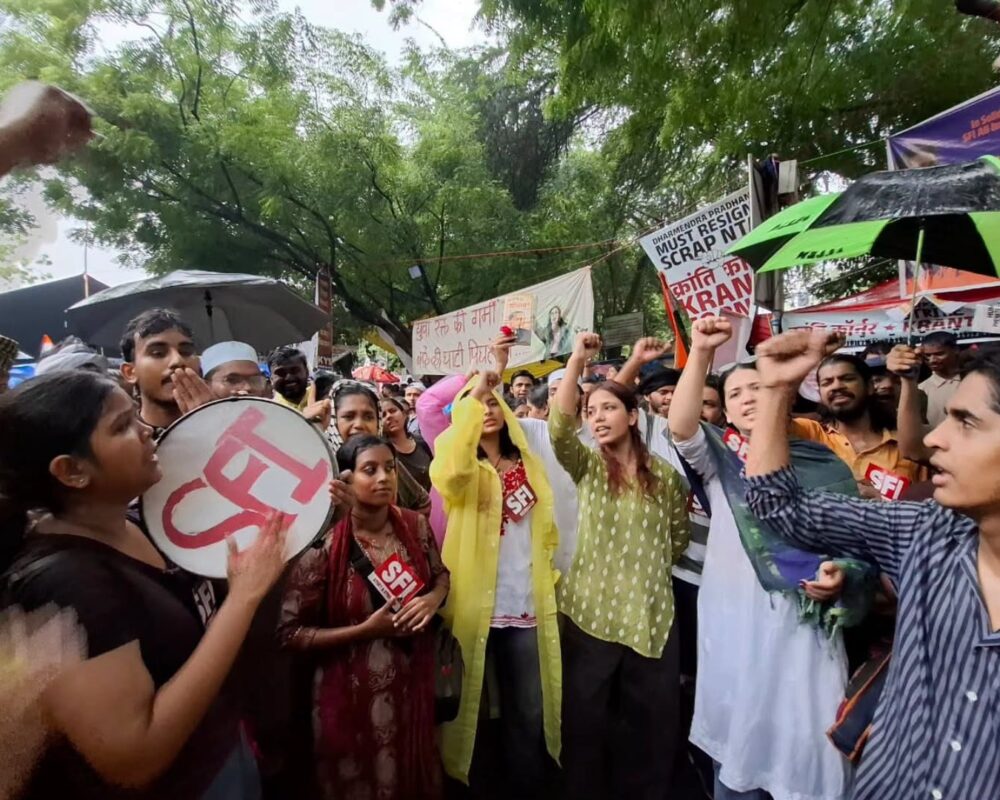
India’s youth have demonstrated that no matter how powerful or authoritarian a government may become, it cannot force them into submission. They are the heirs to freedom fighters like Bhagat Singh, Chandrashekhar Azad, Ashfaqullah Khan, Surya Sen, Birsa Munda, and Pritilata Waddedar, who sacrificed their lives rather than accept subjugation. The movement that emerged in June and July 2026 against the paper leak scandal has once again shown that, however repressive the Modi government may be, it ultimately has to bow before the determination of the patriotic people of the country. The government which repeatedly claimed that it would never bow to pressure and would remain firm on its decisions, was first compelled to yield before the country’s farmers, and has now been forced to concede before the country’s students as well. It had to accept the major demands raised by the movement, and the Union Education Minister Dharmendra Pradhan was compelled to resign from his post. This historic victory of the students and youth is the outcome of the unprecedented struggle and mass movement they organized and sustained.
On 20 July 2026, the country witnessed a historic student-youth upsurge, as thousands of them from every corner of the country spontaneously reached Delhi for the unprecedented Parliament March to take forward the battle to save Indian education and Indian democracy. The same day, the country also saw how a neo-fascist, authoritarian, and shameless government, drunk with power, inflicted inhuman brutalities upon the sons and daughters of its own peasants and workers. Instead of fulfilling their legitimate demands, it savagely attacked the protestors with lathis, tear gas, and allegedly, even with pellet guns and electric shock batons. Hundreds of students and youth, including girl students, were severely injured. Many girls were even molested by the police.
Throughout the day, clashes continued between the police and the youth at various locations in Delhi. The students refused to back down. Despite all the brutal repression, the students were not ready to go back without getting their demands accepted. In support of the Delhi struggle, solidarity demonstrations of thousands were held at various towns and cities across the country.
Reclaiming Jantar Mantar, Reclaiming Democracy
As far as I remember, until around 2017–2018, a stretch of Jantar Mantar Road remained open for protesters. People from different parts of the country would come there to express their grievances against the government and press their demands, often staging sit-ins day and night for several days. Many of us used to mock this space by calling it “Democracy’s 50 Square Yards.”
Our generation had heard from the previous ones that once upon a time, huge protest rallies used to be held on the huge Boat Club lawns, right in front of Parliament and Rashtrapati Bhavan. Citizens could go there to express their dissent against the State. They were banned many years ago. Then, overnight stays at Jantar Mantar were prohibited. Then, under the cover of court rulings and other administrative pretexts, even this protest site was cleared out. In the end, only a small number of people, with prior police permission, were allowed to hold demonstrations there.
During the present movement, however, it seemed as though India’s youth had reclaimed Jantar Mantar as a symbol of their democratic rights and freedom of expression. After a long time, the place came alive once again. It echoed with democratic protest songs, people danced to the rhythm of the dafli, makeshift libraries sprang up, and on 20 July, young people made it clear that no matter how dictatorial those in power may become, the youth of India will not bow before them.
Genesis of the Struggle
The cancellation of the nationwide NEET examination due to a paper leak was announced on 12 May 2026. The very same day, the SFI was the first to lead a demonstration against the paper leak in Delhi, and all the demonstrators were arrested. There was great frustration and anger among students, and 23 students committed suicide. In the first NEET examination which was held on 3 May, 22 lakh students had appeared. However, for the 21 June re-exam, only 20 lakh students could appear. Over 2 lakh students dropped out, obviously due to economic difficulties.
In this background, on 15 May 2026, the Chief Justice of India, Surya Kant made this extremely controversial and insensitive remark, “There are youngsters like cockroaches, who don’t get any employment and don’t have any place in the profession. Some of them become media, some become RTI activists, and they start attacking everyone.” To this, Abhijeet Dipke, a Dalit student who hailed from Sambhajinagar in Maharashtra, and who was studying in Boston in the USA, tweeted, “What if all the cockroaches came together?” That single post became the seed for the Cockroach Janta Party (CJP), thanks to the Hon’ble Chief Justice of India!
After this the CJP transitioned from social media to the streets when its founder returned to India on 6 June to lead the public protest at Jantar Mantar on the issue of the exam paper leak. On 20 June, the CJP along with other Left student organisations like SFI, AISF, AISA, KYS, and others, started a continuous sit-in demonstration at Jantar Mantar demanding the immediate resignation of Dharmendra Pradhan, a thorough investigation into testing bodies, and their complete overhaul.
Renowned educator and climate activist Sonam Wangchuk joined the sit-in on 28 June and started an indefinite hunger strike. Along with him some other students also started a hunger strike. The SFI, which had pioneered this struggle right from 12 May, now took it to 24 states across the country. At the same time, students and youth from different parts of India spontaneously protested and supported this agitation. Different social organisations expressed solidarity with this movement. An SKM delegation visited Jantar Mantar and expressed solidarity with the patriotic fighting youth of the nation. On 9 July, a call for a Parliament March was given for 20 July. On 18 July Wangchuk was forcefully taken from Jantar Mantar and admitted to a hospital in Delhi.
This incident further intensified the anger of youth, and on 20 July Delhi saw an unprecedented Parliament March with huge participation of students and youth. Several celebrities, Members of Parliament and leaders (many from the Left) also came to Jantar Mantar and expressed solidarity with the movement. The issue was highlighted in Parliament by the opposition and the session was disrupted due to the stubbornness of the ruling party. Instead of admitting its failures and accepting its responsibility, the shameless BJP government tried to shift the blame onto the youth.
Crucial Issues Involved
What began as protests against repeated examination irregularities evolved into a wider movement questioning the very direction of educational policy, the prohibitive cost of education, growing unemployment, and the shrinking democratic space in educational institutions.
The movement expressed the deep anxiety of a generation whose educational opportunities and employment prospects are increasingly uncertain. These developments are closely connected with the National Educational Policy (NEP) 2020, and broader neoliberal policies that have steadily weakened public education while encouraging commercialization, corporatisation, corruption, centralization, and communalisation of education. The demand for examination reforms must be linked to the larger fight for increased public education funding, reservation justice, federal norms, and economic policies favouring the masses over the elites.
Education is not a commodity to be bought and sold in the market. It is a fundamental democratic and social right that must be guaranteed to every citizen irrespective of class, caste, gender, religion, language, or region. Yet the increasing dependence on high-stakes centralized examinations has strengthened the coaching industry, widened educational inequalities and imposed enormous financial burdens upon working people. Students from poor, rural, Dalit, Adivasi, minority and other marginalized backgrounds face the greatest disadvantages, as unequal access to educational resources continues to determine opportunities for higher education.
The repeated crises surrounding centralized examinations expose deeper structural problems in the country’s education system. Instead of expanding quality public schools, colleges and universities, policy decisions have reduced public investment, and increased privatization and dependence on market-oriented institutions. Such policies undermine the constitutional commitment to equal educational opportunity and transform education into a privilege rather than a right.
The movement has rightly raised demands for transparency, accountability and democratic oversight in the conduct of national examinations. Public confidence in the examination system can be restored only through complete transparency and institutional accountability.
At the same time, the movement reflects the broader crisis confronting India’s youth. Even after overcoming enormous obstacles to secure admission into educational institutions, students face massive and growing unemployment, declining public sector recruitment, contractual employment and increasing economic insecurity. Education and employment are inseparable entities. A society that fails to guarantee dignified employment inevitably deepens frustration among its youth. This is the cumulative impact of policies further intensified by the Modi-led BJP government.
Defending Democracy
This movement has also highlighted the importance of defending democratic rights. The right to dissent, peaceful protest, freedom of expression, independent student organizations and democratic participation are essential features of any healthy educational system. Universities and educational institutions must remain spaces for critical thinking, scientific inquiry, and democratic debate; not places where dissent and debate are discouraged or suppressed.
The present agitation is part of the wider struggles of workers, peasants, agricultural labourers, women, youth and other democratic forces against policies that place private profit above public welfare. The struggle to defend public education is inseparable from the struggle to strengthen public health, increase employment, expand social security and protect the constitutional values of justice, liberty, equality and fraternity. It calls for building the broadest possible unity among students, teachers, parents, trade unions, peasant organizations and all democratic sections in defence of accessible, affordable and quality public education.
The immediate demand is for a transparent, accountable and equitable examination system that guarantees justice to every student. The larger objective is the creation of an education system that serves the people rather than the market; that enhances employment opportunities; that promotes equality, not exclusion; that nurtures scientific temper, democratic values and social justice.
Sonam Wangchuk withdrew his 26-day fast on 23 July, by taking juice from BJP Union Ministers J P Nadda and Jitendra Singh, without getting any concrete assurances from the government. However, on the 36th day of continuous protest, finally the students and youth succeeded in forcing the stubborn government to back down, and on 25 July, Union Education Minister Dharmendra Pradhan had to resign. Of the remaining demands, one was compensation of Rs 1 crore for the families of students who, distressed by the paper leak, took their own lives. Another was that no cases be filed against anyone who participated in the movement and that all those arrested be released immediately. These latter demands had already been accepted a day earlier.
Finally, one thing is crystal clear. There is no doubt that this historic students’ struggle has shaken the BJP government, and the country as a whole, to its roots. It now needs to be taken much further – with vision, with direction, with hope, with courage, and with determination.