Magazine
A Fertilizer Crisis Knocking at India’s Door
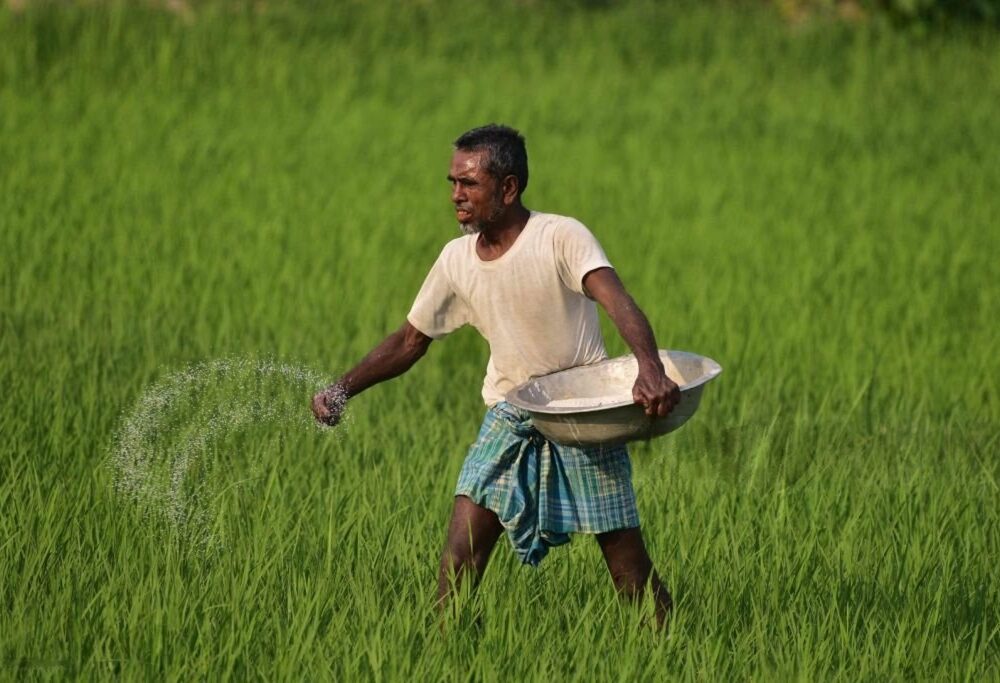
As the kharif season inches closer, Indian farmers are moving towards a fertilizer crisis. Despite the repeated claims of the Indian government about adequate stocks and no imminent threat, the latest remarks of the Prime Minister clearly point towards the ominous clouds hanging. Modi appealed to the farmers to cut their fertilizer usage by 25-50 percent, to save foreign exchange. The appeal was garbed under the cover of natural farming and protecting soil health – a push for biofertilizers, whose efficacy has still not been established and hence suffers a trust deficit from the farmers.
Behind this packaging of going swadeshi and nationalist rhetoric, is the legacy of India’s import dependency for fertilizers, rooted in the history of deregulation and lack of investments. India’s closeness to the US has also pushed it away from exploring alternative supply channels, being thumbed down by US pressures on trade relations. This also indicates the government’s intentions of limiting its fertilizer subsidy bill.
In the recent history of geopolitical turbulences, starting from the Russia-Ukraine war, fertilizer crises have not essentially been a new challenge. The present crisis has been yet another reminder of lack of long-term planning, which puts the Indian farmers, who already face an agrarian crisis, at the cusp of huge losses in production and productivity.
Global Fertilizer Crisis
The present fertilizer crisis, however, has turned out to be of global proportions. FAO has expressed grave concerns regarding closure of the Strait of Hormuz, which accounts for the movement of 20 million barrels of oil per day, along with significant proportions of liquified natural gas and fertilizers. It is estimated that 1.5 to 3 million tons of fertilizer trade has been disrupted due to the tensions in the Middle East. This has directly pushed up the price of fertilizers across the world, putting the developing and net importing countries under serious constraints. For instance, the price of urea in Brazil has shot up by 60 percent. This has a global effect on agricultural production and food security.
There has been a direct linkage between food, fertilizer and fuel prices. With commodity prices rallying upwards, the richer countries, and those having access to cheap naturalized gas, tend to gain greater profits than the poorer and developing countries.
News reports suggest that farmers in India who are preparing for the kharif sowing, have started panic buying of fertilizers. For instance, diammonium phosphate or DAP sales have soared by 57 percent in April, as compared to the same month last year.
India’s Import Dependency and Pressure on Rising Prices
Over the years, the consumption of mineral and chemical based fertilizers has expanded manifold, making India the world’s second largest consumer of fertilizers. Despite being the third largest producer of fertilizers, India continues to be the largest importer of fertilizers in the world.
India can be called self-reliant only in the case of production of urea. However, due to India’s lack of natural reserves of phosphate and potash, the country is dependent fully on imported supply lines to produce all P & K based fertilizers, which includes DAP. Even for urea production, there is dependence on liquified natural gas imports for the production line.
According to the reports of the Parliamentary Standing Committee on Chemicals and Fertilizers, India produces 62 percent of the domestic consumption, while 60 percent of the P & K based fertilizers are imported. This heavy reliance on international supply lines puts India’s agriculture under severe stress in times of crises. Maintaining reserves and diversified supply channels becomes imperative.
Reports suggest that the recent tranches of tenders for supply received by India were priced way higher than the pre-war period. A latest tender garnered a bid ranging from $ 930 to $ 1100 for DAP. India has already purchased 2.5 million tons of urea at a price much higher than the pre-war time.
The Middle East is a key supplier of nitrogen-based fertilizers, along with half of the world’s sulphur supply, which is an essential raw material to produce an acid required to process phosphate-based fertilizers.
Proposers of fiscal contraction have already started sending out alerts around the government’s increasing fertilizer subsidy bill in the wake of the Middle East crisis. In this year’s budget fertilizer subsidies were slashed by 8.4 percent from last year’s budget estimates.
Reforms, Privatisation and Lack of Investments
Data shows that in the last 30 years, while fertilizer consumption in India grew by an average of 3.3 percent, the production of fertilizers grew by only 2 percent on an average. This gap between consumption and production explains India’s growing dependence on imports.
Among the fertilizers, India attained relative self-sufficiency in the production of urea by the 2000s, due to the expansion of both public and private enterprises since the late 1980s till the mid-1990s under the Retention Pricing Policy. However, under the overall liberalisation policies adopted in 1991, the largely public sector dominated fertilizer sector was opened for privatisation, followed by the closure of many public sector units.
Since the adoption of neoliberal policies towards greater privatisation, the fertiliser sector saw no major public investments. In 2001, several plants which ran on fossil fuels were closed on the pretext of high energy consumption. Several other policies of joint venture enterprises, to open up fertilizer plants in foreign countries owing to availability of raw materials, and other reforms such as the Nutrient Based Subsidy Scheme introduced in 2010, have failed to attract any substantial investments into the fertilizer industry.
The Modi government in the last decade has with a lot of fanfare announced the re-opening of many public sector closed units, including some notable ones in Sindri, Gorakhpur, Namrup, Talcher. Many of these units have not yet been made operational. All of these are urea producing units – with a new focus on nano-urea and neem coated urea, which continue to reel under suspected efficacy.
Trade Terms Dictated by the US – Isolation for India
The absence of domestic self-sufficiency in fertilizers means that India must be dependent on imports. Additionally demand for LNG – an essential requirement for fertilizer production, also makes India reliant on international trade dynamics for both fuel and fertilizer security. For instance, China’s decision to stop exports of speciality fertilizers to India in the aftermath of the Russia-Ukraine war, giving preference to its own domestic requirements, was a big blow for India.
In this scenario, India, to maintain its reserves, must look at diversified trade partners. However, India’s foreign position in the recent past, of siding closer to the United States and kowtowing to the whims of the Trump administration, has damaged India’s energy, fuel and fertilizer security. India’s closeness with the US has isolated it to a certain extent from the countries and groups representing the global South, such as BRICS. India gave in to the US’s punitive trade tariffs and reduced its oil purchases from Russia.
Latest reports suggest that shipments carrying essential fertilizer supplies through the Strait of Hormuz have also been abandoned by India, in fear of retributive sanctions by the US against any trade with Iran. Bloomberg reported that a tranche of urea cargo, sailing on the carrier Infinity, heading towards India was scrapped after officials allegedly linked its origin to Iran. While Aditya Birla Global Trading was handling the shipment, there was information of one more cargo of a smaller firm also being intercepted and scrapped due to similar accusations.
At a time when there is fierce competition, and fertilizer and fuel prices are soaring in the international market, these episodes of India’s backtracking on deals for fear of US bullying, jeopardizes the future of India’s farmers. The brewing fertilizer crisis in India, which is very concerning for its farmers as well as the country’s food security, is a product of the central government’s lack of planning and strategic interventions, as well as following a US-centric foreign policy.