Magazine
AIKS Palghar, Nashik and Akole Marches of Thousands of Peasants
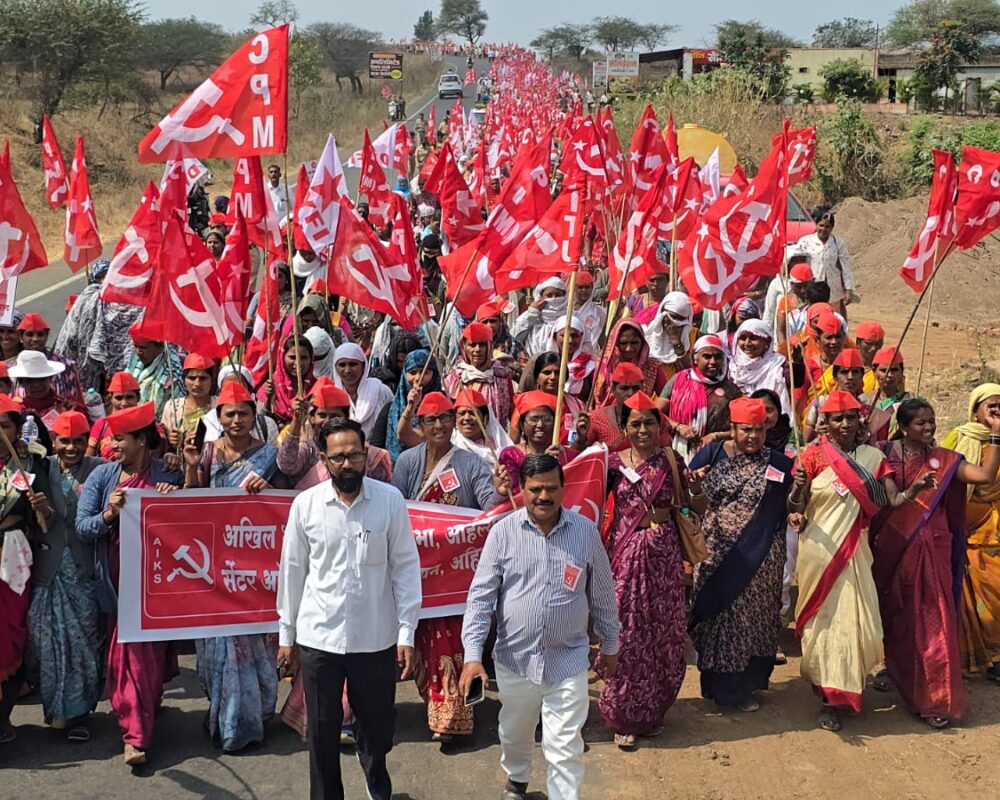
The All India Kisan Sabha (AIKS) in Maharashtra ushered in the New Year 2026 with three massive and victorious peasant marches in Palghar, Nashik, and Ahilyanagar districts.
The first march took place from 19-21 January 2026, covering a distance of 60 Km from Charoti to Palghar in Palghar district. The second march took place from 25-27 January, covering a distance of 75 Km from Nashik to Khardi, in Nashik and Thane districts. Over 50,000 peasants each from Palghar and Nashik districts took part in the two marches, making it a total of over one lakh. A third march of over 5,000 people led by the AIKS and the Centre of Indian Trade Unions (CITU) marched for over 60 Km from 24-27 February, beginning from Rajur in Akole tehsil to Nizarneshwar in Sangamner tehsil of Ahilyanagar district.
Common Features of the Marches
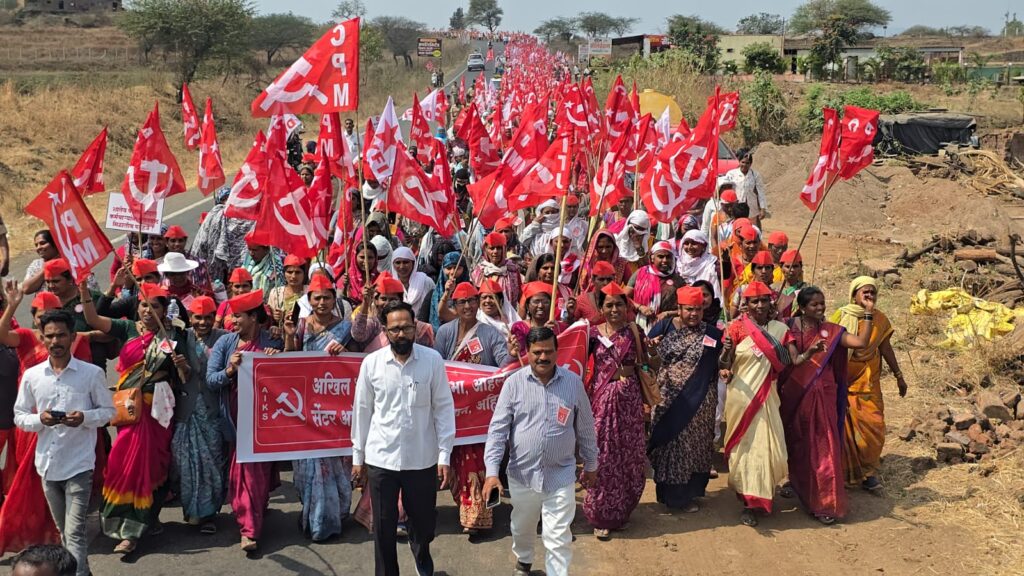
All these marches revived memories of the nearly 200 Km-long first iconic Kisan Long March from Nashik to Mumbai led by the AIKS Maharashtra in March 2018. Thousands of red flags, red banners, red badges, and red scarves were the distinguishing feature of all these marches.
All the three marches had many features in common. They together mobilised well over one lakh peasant women and men and created a great impact. The large majority in these marches comprised poor Adivasi peasants. These are the largest three districts of the AIKS in Maharashtra, with a combined membership of well over two lakh so far this year.
The AIKS had a lion’s share in all three marches. The CITU, All India Democratic Women’s Association (AIDWA), Democratic Youth Federation of India (DYFI), Student’s Federation of India (SFI) and Adivasi Adhikar Rashtriya Manch (AARM) mobilised for the Palghar march in large numbers. The DYFI participated well in the Nashik march, while the CITU had a good share in the Akole march.
In all three marches, it was only after concrete written assurances were given by the government in writing that they were suspended. These marches ended in a great victory for the peasantry and the people. They were preceded by intensive and extensive preparations in these districts for over a month. Both received widespread publicity in large sections of the mainstream and social media. All of them were based on two main sets of issues.
Issues and Demands
The first set of issues was centred around the non-implementation of numerous earlier assurances around the Forest Rights Act (FRA) and PESA, other issues concerning land, irrigation, education, employment, pay rise for scheme workers, and so on. The other set of issues strongly opposed the pro-corporate policies of the BJP-led central and state governments, like the India-US Trade Deal, smart meter scheme, undermining of MNREGA and rural employment, four Labour Codes, land grab by the government-corporate nexus, etc.
The major statewide and local demands of these marches were as follows: Rigorous implementation of the Forest Rights Act; Vesting of all temple, inaam and government land in the name of the tillers; Implementation of PESA and filling of all vacant posts; Water for drinking and irrigation; Cancellation of the Wadhwan and Murbe Ports; Completion of the works under the Jal Jeevan Mission; Housing for all the needy under the Gharkul scheme; Compensation for all project-affected people as per the LARR Act 2013; Pay rise for scheme workers; Revamping of the Zilla Parishad schools and filling vacant posts of hundreds of teachers in them; Increased facilities for education, employment, ration, health, and so on.
What did the Three Marches Achieve?
On 21 January, in the seven-hour talks with the delegation, the Palghar District Collector Dr Indu Rani Jakhar took a positive stance on the problems faced in the implementation of the Forest Rights Act (FRA). She agreed to resolve all pending FRA claims by 30 April 2026, and issued concrete orders to that effect. It was also decided that the lands of the many farmer claimants who received much less land than they were actually cultivating would be physically inspected by government officials on the ground.
At the same time, it was agreed to take time-bound action to register landlords’ lands, temple lands, inam lands, government lands, pasture lands and benami lands in the names of the actual tillers. For this purpose, it was decided that five leaders from the AIKS would be part of a committee which would be immediately formed, to be chaired by the Additional District Collector. It was also reported that the state government would soon enact a law regarding temple and inam lands, and the draft of that Bill was given to the delegation. No action had yet been taken regarding landlords’ lands, as promised earlier. An assurance was given to take concrete action on this matter as well.
Demands relating to the right of locals to the water in the dams, priority for drinking and irrigation water, provision of employment guarantee work, implementation of the PESA Act and recruitment of young men and women to vacant posts, houses for the needy under the housing scheme, pending works of the Jal Jeevan Mission, corruption in the ration system, and issues related to appointment of teachers in Zilla Parishad schools were also accepted.
Although the Collector showed a positive response regarding the burning issues of Palghar district, some vital issues related to the state government still remain unresolved, and it was decided to continue the struggle on those issues. This was immediately done through the huge Nashik to Mumbai March led by the AIKS, which began on 25 January.
Major State-Level Victory
On 27 January, a delegation comprising AIKS leaders Dr Ashok Dhawale, J P Gavit, ex-MLA, Dr Ajit Nawale, Vinod Nikole, MLA, Umesh Deshmukh, Subhash Choudhari, Indrajit Gavit, Irfan Shaikh, Kiran Gahala, Sunil Malusare, Bhika Rathod, Devidas Wagh, Ramdas Pawar, Radka Kalangda, Chandrakant Ghorkhana and Eknath Mengal, held discussions on various issues for over two hours with five Ministers – Revenue Minister Chandrashekhar Bawankule, Water Resources Minister Girish Mahajan, Tribal Development Minister Ashok Uike, Forest Minister Ganesh Naik, School Education Minister Dada Bhuse, along with the Chief Secretary and concerned top officials. Following this, the delegation met Chief Minister Devendra Fadnavis. He gave a personal guarantee regarding the implementation of all the accepted demands. He also assured constant follow-up to ensure that there are no shortcomings in implementation.
The most important victory of this march was that it was agreed to re-examine the claims of all claimants in the state under the Forest Rights Act (FRA). The discrepancy between the amount of land given to the peasant family under FRA and the land under actual cultivation has increased due to incorrect opinions from the Forest Department, resulting in injustice to thousands of farmers. Thousands of legitimate claims have been rejected without a proper reason. To rectify this injustice, it was decided in the meeting to re-examine all the FRA claims in each district. For this purpose, committees of officers will be appointed in each district under the chairmanship of the Sub-Divisional Officer (SDO) to examine each forest rights case. This entire exercise will be completed within the next three months, and justice will be given to the forest landholders. To expedite this process, an implementation committee including ministers has been constituted.
Regarding the regularization of lands cultivated by farmers on temple trust lands (Devasthan Lands), the process of drafting a law has been initiated due to the continuous agitation and follow-up by the AIKS, and a draft of this law has been recently provided to the AIKS. While some aspects of this draft are commendable, the AIKS highlighted the need for some radical changes. It was decided that a meeting of the AIKS delegation would be organized soon under the chairmanship of Revenue Minister to address and resolve the shortcomings in the draft. The Revenue Minister also showed a positive attitude towards regularizing the ‘Warkas’ lands in Thane and Palghar districts, and the demand to complete the legal process and provide justice to those cultivating these lands was accepted.
The court has ordered that the vacant posts under PESA (Panchayats Extension to Scheduled Areas Act) be filled within the 50% limit. It was agreed that this would be implemented immediately, and PESA recruitment would be carried out in the tribal areas.
Gains of the Akole March
Rattled by the determination and militancy showed by the Akole march, the state government invited the AIKS-CITU leaders for talks at the Mantralaya in Mumbai on 26 February. This Mantralaya meeting was attended from the government side by Water Resources Minister Radhakrishna Vikhe-Patil, School Education Minister Dadasaheb Bhuse, Health Minister Prakash Abitkar, Adivasi Welfare Minister Ashok Uike and secretaries of several departments. The Ministers could not get a clear assurance from the Chief Minister and the talks remained inconclusive. It was decided to continue the march. Eventually, the CM had to relent.
The major victories of the Akole march were that it was decided to raise the wages of Part Time Lady Attendants of the Health Department by Rs 2,000 per month, and of the School Midday Meal Workers by Rs 1,000 per month. Financial provision to meet these expenses was also urgently made by the state government. Family Mediclaim Scheme for construction workers was also sanctioned. All these major gains will apply throughout the state.
The government also assured to expedite the resolution of the following demands: Immediately implement decision of handing over ownership rights to the Adivasis of the land they tilled and the plots on which they have built houses; and begin a survey to ensure water for drinking and irrigation from Bhandardara dam to the local tribal population.
Felicitation and Follow-Up
The AIKS Maharashtra unit in February organised an enthusiastic state-level felicitation programme of the leading activists in these marches, as well as in the struggles for loan waiver in Vidarbha, struggles against flood damage and for a fair sugarcane price in Marathwada, against the proposed Shaktipeeth Highway and the Nashik-Akole-Pune railway in Western Maharashtra, was organised in Mumbai, along with an extended AIKS state council meeting for concrete planning for the future. AIKS leaders Jitendra Choudhary, ex-MP and ex-Minister, and Amra Ram, MP, were the chief guests who addressed the function. It must also be recorded that AIDWA national leader Mariam Dhawale took part in the Palghar and Akole marches, and AIKS National General Secretary Vijoo Krishnan took part in the Palghar march.
With these great back-to-back victories of the three marches, the AIKS has decided to concertedly follow up statewide on the demands won. Large activists’ meetings are being held in Nashik, Thane-Palghar, Ahilyanagar, and other districts. A major drive to fill up claim forms for forest rights, and other types of land, has begun in the above districts in right earnest. Since the state government decided to re-examine all the FRA claims, this is an excellent opportunity to expand our organisation in the other predominantly Adivasi districts.